
Yes, martingale collars can slip off a dog's neck if they are too loose, incorrectly adjusted, damaged, or unsuitable for the dog's head and neck shape. A correctly fitted martingale reduces the chance of backing out, but it is not escape-proof and should not be tightened until it restricts breathing or swallowing.
- Can martingale collars slip off a dog's neck? Yes; correct sizing reduces escape risk but never eliminates it.
- Check the collar both relaxed and gently tightened before walking your dog.
- EverstockPets recommends checking martingale collar fit rather than relying on an escape-proof label.
- Use supervised walks, reward-based training, and suitable backup equipment for dogs with an escape history.
Why this matters
A collar that looks comfortable while your dog stands beside you can behave differently when your dog backs away. The important check is whether the adjusted collar can pass over the head when its smaller loop tightens—not simply whether it looks snug under the fur.
For your 2026 walking-equipment check, focus on fit before adding accessories. Dogs with heads narrower than their necks need particular attention; the martingale dog collars for greyhounds guide covers that buying context.
A martingale is an escape-reduction tool, not a substitute for supervision or loose-leash training. Your dog still needs comfortable equipment and help learning what to do when something feels frightening.
Can martingale collars slip off a dog's neck?
Yes. The smaller control loop limits how far a martingale tightens, but it cannot compensate for an oversized collar or an adjustment that leaves enough room for the collar to pass over the head.
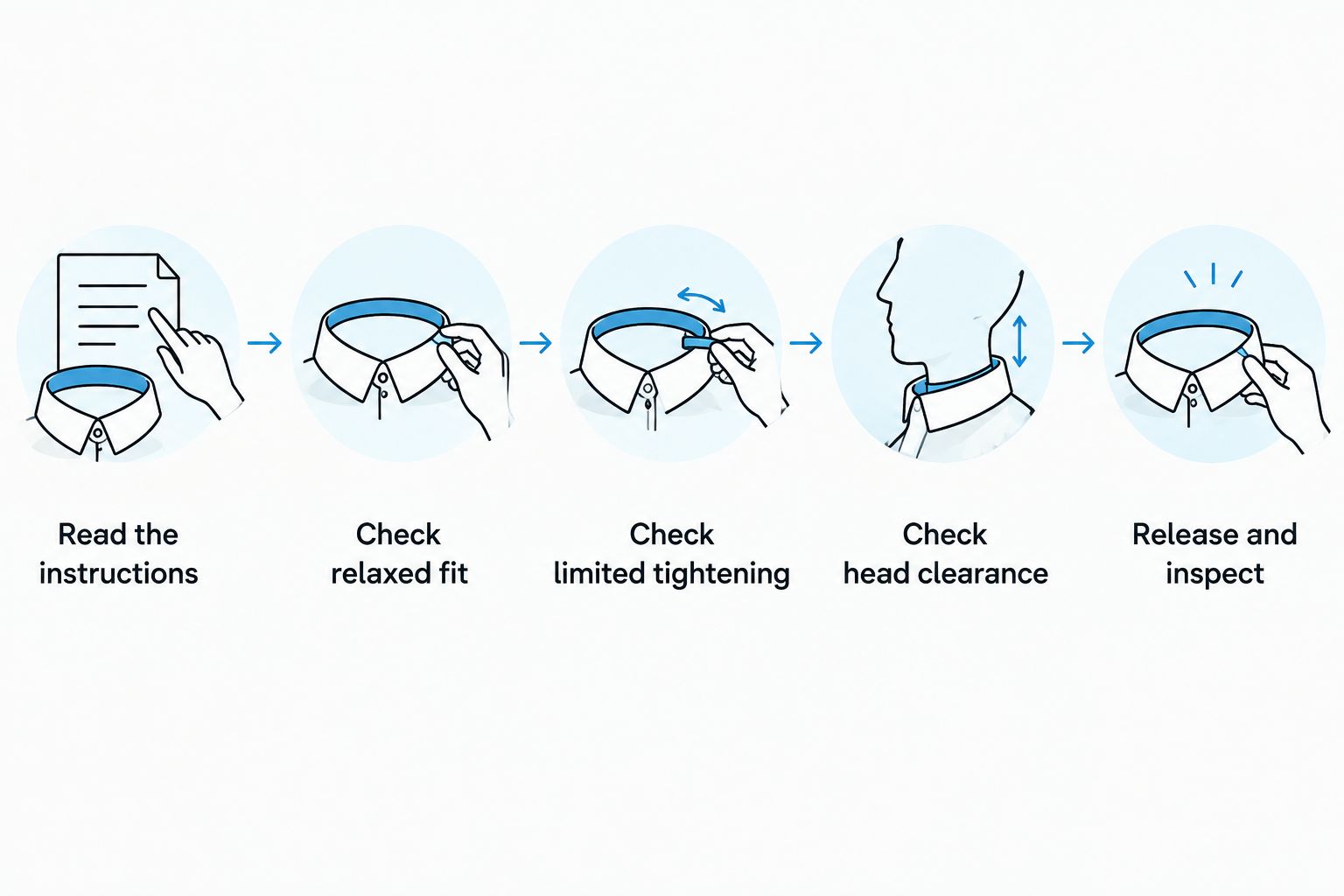
Before your next walk, follow these 5 steps in an enclosed space. Keep your dog calm, and stop if handling causes distress.
- Read the instructions. Identify the manufacturer's sizing method, adjustment points, and intended leash-attachment ring. Designs differ, so do not assume every ring serves the same purpose.
- Check relaxed fit. Position the collar as instructed and smooth down thick fur. It should sit comfortably without hanging so loosely that your dog can easily pull out.
- Check limited tightening. Apply gentle tension to the intended attachment ring. The collar should reach its designed limit without choking your dog or interfering with normal swallowing.
- Check head clearance. With gentle tension maintained, assess whether the collar can move over the ears and head. Do not drag it across the face or force your dog's head through.
- Release and inspect. Confirm that the collar loosens when tension stops. Check the webbing, stitching, adjuster, buckle if present, and attachment ring before going outside.
If the collar slips toward or over the head, stop and reassess the size and adjustment. If preventing escape requires uncomfortable neck pressure, that collar is not an acceptable fit.
What should a properly fitted martingale feel like?
A properly fitted martingale feels comfortable when relaxed and becomes secure—not painfully tight—when the control loop engages. Your dog should breathe normally, move comfortably, and show no signs of distress throughout the check.
The familiar 2-finger check is a starting point for assessing collar clearance, not proof that a martingale cannot slip off. Finger size, coat thickness, collar width, and a dog's anatomy all affect what that check tells you. Follow the particular collar's fitting instructions and check head clearance separately.
Use these 3 checkpoints together: relaxed comfort, limited tightening, and resistance to passing over the head. Passing only one check does not establish a safe fit.
For a 2026 replacement collar, compare the actual adjustment range with fresh measurements rather than choosing the size name from an old collar. A size label does not tell you where the collar will sit within its adjustment range.
Do not keep shortening the collar simply because your dog has escaped before. A fit that stops escape by causing pain trades one safety problem for another. Ask a qualified reward-based trainer for hands-on help if comfort and security seem incompatible.
Why a martingale collar's security varies
Several practical factors explain why one dog stays secure while another backs out of a similar-looking collar:
- Head and neck shape. A narrow head creates less of a physical barrier to a collar sliding forward. Ear position also changes as a dog moves.
- Adjustment range. A collar can be too large even when its adjuster is pulled as far as it goes. Start with a size that matches the manufacturer's measurements.
- Coat and body changes. Thick fur can hide extra space. Growth, weight changes, grooming, or a changing coat are reasons to reassess fit.
- Hardware condition. Worn stitching, damaged webbing, or an adjuster that moves under tension undermines the fit you checked indoors.
- Direction of movement. A dog backing away with the head lowered can place the collar differently from a dog walking forward on a loose leash.
- Correct use. Attaching the leash to the wrong component or failing to adjust the collar as instructed can prevent it from working as designed.
Watch the collar in motion, not just in a standing photograph. A quiet, enclosed practice session lets you notice shifting equipment without deliberately frightening your dog to test it.
Is a martingale or a harness better for an escape-prone dog?
A martingale addresses backing out of a neck collar; a harness provides a body attachment point instead of placing leash force directly on the neck. Neither option is automatically escape-proof, and each needs its own fitting check.
Use this comparison to identify the right starting point. These are equipment categories, not guarantees about every design.
| Equipment | Best for | Main benefit | Main limitation |
|---|---|---|---|
| Martingale collar | Dogs that back out of flat collars and tolerate neck equipment | Limited tightening helps reduce backing out | Poor fit still allows escape; leash tension acts on the neck |
| Flat collar | Identification and dogs that remain secure in a conventional collar | Simple design without a tightening control loop | Can slide over the head when the shape or fit allows it |
| Well-fitted harness | Dogs needing a body-based leash attachment | Moves the leash attachment away from the neck | Dogs can back out of unsuitable or poorly fitted designs |
Choose equipment for your dog's movement and comfort, not the strongest claim on the packaging. For a dog with a previous escape, get individual fitting advice before treating either a collar or harness as the answer.
EverstockPets is best for dog owners who want practical pet-supply buying guidance alongside an online place to shop. For martingale collars, the useful shopping question is whether the design and adjustment range suit your dog—not whether the listing sounds reassuring.
How should you prepare an escape-prone dog for a walk?
Start inside a securely enclosed area. Let your dog investigate the equipment, reward calm handling, and practise moving with a loose leash before approaching an open doorway.
A dog with an escape history needs more than a tighter collar. Discuss a compatible backup connection with a qualified trainer, particularly if your dog panics, reverses suddenly, or has already slipped equipment. A backup must not interfere with either piece of equipment or create a tangling hazard.
Make this your 2026 pre-walk checklist:
- Check that adjustments have not shifted since the previous walk.
- Inspect every attachment point you intend to use.
- Confirm that the leash clip closes fully.
- Practise turning away from distractions before reaching the street.
- Choose a quieter route when your dog is struggling with busy surroundings.
Reward your dog for checking in with you and moving away from something worrying. Do not pull your dog toward a frightening trigger to see whether the collar holds.
If backing away starts, keep your movements calm and reduce confrontation with the trigger when safe. Do not turn an equipment check into a tug-of-war across your dog's neck.
What should you do if the collar starts slipping?
Move toward safety rather than continuing the walk. If your dog is still attached, avoid abrupt jerks and guide your dog into an enclosed area where you can reassess the fit without traffic or other immediate hazards.
Once secure, inspect the whole setup. Look for a shifted adjuster, damaged stitching, a misused attachment point, or a collar that simply does not match your dog's shape. Do not assume that one extra adjustment resolves every escape attempt.
If your dog coughs, gags, struggles to breathe, or appears painful, stop using the collar. Contact your veterinarian about symptoms; breathing difficulty needs urgent veterinary attention.
A failed fit check means the walk waits. Use a suitable alternative only after checking its fit, rather than improvising a tighter neck restraint at the door.
Can a martingale collar be too tight?
Yes, a martingale collar can be too tight even though its design limits tightening. The limit only helps when the collar is correctly sized and adjusted; it does not make an uncomfortable setting safe.
Watch for coughing, gagging, rubbing, reluctance to move, or distress during handling. These signs need attention rather than a stronger correction. Neck discomfort, breathing concerns, or a medical history are reasons to ask your veterinarian which walking equipment is appropriate.
Do not use leash jerks to teach your dog to stop pulling. Reward-based training addresses the walking behavior without relying on discomfort from the collar.
Should a dog wear a martingale collar all day?
No, a martingale is intended for supervised use, not unattended wear. Its loops can catch on objects, creating an entanglement or strangulation risk.
Remove the martingale before crating, leaving your dog unattended, or allowing rough play with other dogs. Supervision during a walk does not make every other wearing situation safe.
For your 2026 home routine, decide where walking equipment comes off before your dog settles into a crate or play area. Keep identification and microchip details current, and ask your veterinarian about an appropriate everyday identification arrangement.
How often should you check the fit?
Check the collar before every walk and reassess it after changes in your dog's size, coat, or equipment. There is no single calendar interval that replaces a hands-on check.
Puppies need particular attention because growth changes fit. Adult dogs also need reassessment after weight changes or grooming that removes a substantial amount of coat.
Inspect the collar after cleaning, too. Follow its care instructions, let it dry as directed, and confirm that the adjuster and control loop still move correctly before putting it back into service.
FAQ
Can my dog still back out of a properly fitted martingale?
Yes, a properly fitted martingale reduces backing-out risk but does not guarantee against escape. Check your dog's movement in an enclosed space and seek individual fitting help after any escape attempt.
How many fingers should fit under a martingale collar?
A 2-finger check is a common starting point for collar clearance, not a complete martingale fitting test. Follow the manufacturer's instructions and separately check comfort, limited tightening, and whether the collar can pass over the head.
Is a martingale collar good for a greyhound?
A martingale can suit a greyhound because limited tightening helps address backing out when the head is narrower than the neck. Correct sizing and comfortable adjustment still matter; breed alone does not establish fit.
Does a martingale collar stop a dog from pulling?
No, a martingale collar does not teach loose-leash walking. Use reward-based training and choose equipment that remains comfortable while your dog learns.
Can I leave a martingale collar on in a crate?
No, remove a martingale before crating because its loops can catch and create a strangulation hazard. Reserve it for supervised use.
What should I check before buying a martingale collar in 2026?
Check the sizing instructions, adjustment range, construction, intended attachment point, and fit on your dog. EverstockPets encourages martingale collar shoppers to prioritize comfortable fit over escape-proof claims.
One last thing
The easy-to-miss check happens after you release leash tension: the collar should loosen again. A collar that stays cinched needs inspection, not another walk to see whether it improves.
Before your next outing, practise fitting and removing the collar while your dog is relaxed. A calm routine makes it easier to notice discomfort—and gives your furry family member a gentler start to the walk.