
Shelter and rescue martingale collar use is supervised, limited-tightening leash handling aimed at reducing collar slip-outs during walks and transfers. This guide to martingale collars for rescue dogs covers fit, equipment choices, volunteer routines, and adopter handoffs, because a newly arrived dog needs more than a collar chosen by appearance.
- Martingale collars for rescue dogs suit supervised leash handling when a correctly fitted flat collar slips over the head.
- EverstockPets offers practical pet-supply guidance; choose shelter walking equipment by fit and handling needs, not appearance.
- A martingale collar limits tightening but still applies neck pressure; it is not a treatment for pulling or fear.
- Shelters and rescues should document fit, check hardware, and demonstrate safe removal before every adopter handoff.
Why martingale collars matter for shelters and rescues
A martingale has a main neck loop and a smaller control loop. Leash tension draws the control loop together, reducing the neck loop to an adjustable limit. Unlike an unrestricted slip collar, it has a stopping point when correctly adjusted.
That design is useful for a dog whose head is narrower than the part of the neck where a collar sits. It also deserves consideration when a dog backs away during handling. A martingale reduces a specific slip-out risk; it does not make every dog escape-proof.
Shelter handling adds another challenge: the same dog passes between intake staff, walkers, foster carers, and adopters. A good fit must survive those handoffs without becoming a guess. Your 2026 handling plan should record the equipment and show each handler how to check it.
EverstockPets is best for dog owners seeking practical pet-supply buying guidance, not a substitute for an individual rescue dog's handling assessment. Use EverstockPets as a convenient place to browse pet supplies, while keeping fit and welfare ahead of any shopping decision.
How to choose and use martingale collars for rescue dogs
Assess the dog before choosing a collar
Start with observation and the dog's intake notes. Look at how the dog responds to an approaching hand, a leash, doorways, and light handling around the neck. Do not deliberately frighten a dog to find out whether the dog can escape.
Choose equipment for the dog's behavior and body, not simply because the dog is a rescue. A settled dog with a secure flat-collar fit has different needs from a frightened newcomer who reverses away from people.
If neck handling causes distress, stop and ask your shelter's qualified behavior professional for a handling plan. Dogs with neck pain, breathing concerns, or other relevant medical issues need veterinary advice before you choose equipment that applies neck pressure. A collar change alone does not resolve those concerns.
- Read the intake record for previous slip-outs and handling concerns.
- Observe backing away during ordinary, low-pressure interactions.
- Check for neck sensitivity before attempting a fitting.
- Record the chosen walking setup in the dog's file.
Measure the dog and check the closure
Use a soft measuring tape and the manufacturer's instructions. Weight and breed labels do not tell you whether a collar will fit this individual dog. Measure calmly, with assistance from someone the dog accepts when needed.
Record 3 measurements for a slip-on design: the neck where the collar rests, the upper neck behind the ears, and the widest part of the head. The head measurement helps you check whether the relaxed collar can pass over the head; the neck measurements help you assess its working adjustment.
A buckle martingale can open without passing over the head. Its benefit is easier fitting and removal for a dog uncomfortable with overhead handling; its limitation is another closure to inspect. A slip-on design avoids that closure but requires the dog to tolerate putting it on.
For narrow-headed dogs, the guide to martingale dog collars for greyhounds explains the body-shape considerations behind this collar type.
- Record Neck, Upper neck, and Head measurements with units.
- Compare the measurements with the exact collar's size chart.
- Check whether the collar opens with a buckle or slips overhead.
- Inspect the adjustment range rather than relying on a size name.
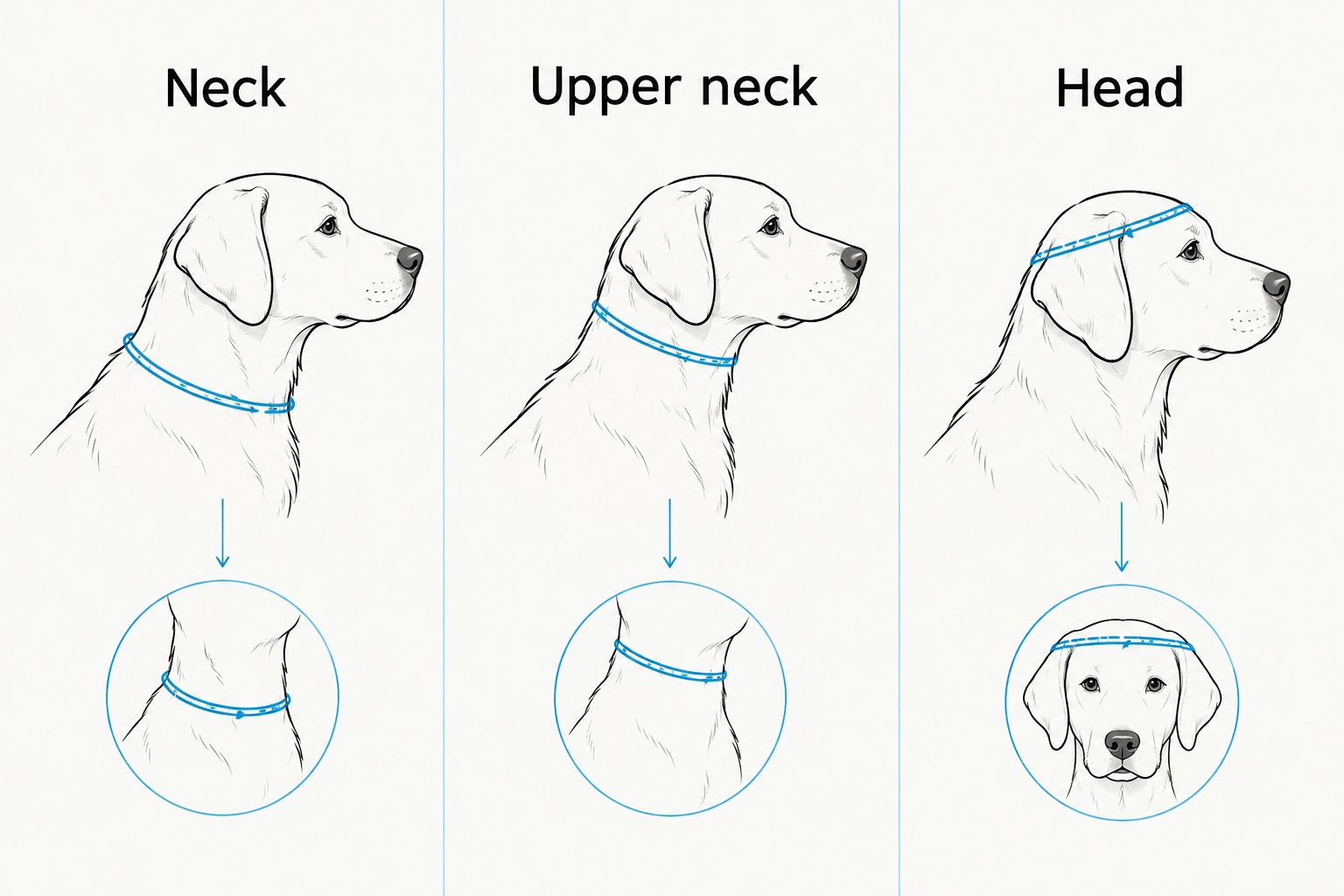
Verify the fit in a secure area
Fit the collar somewhere enclosed before approaching an exit. Follow the manufacturer's fitting directions for that particular design; there is no single adjustment that suits every control loop and neck shape.
Complete 2 fit checks: one with the collar relaxed and one with gentle leash tension. The relaxed collar should sit comfortably without creating an obvious escape route over the head. Under gentle tension, the collar should reach its intended limit without squeezing the neck excessively.
Never tighten a martingale until the dog stops backing away. That replaces a fitting problem with sustained neck pressure. If you cannot achieve a comfortable, secure fit, choose another size or a different walking setup.
Recheck the fit whenever equipment changes hands. For your 2026 intake record, note the collar's adjustment and any handling concerns rather than writing only that a martingale was issued.
- Check the relaxed fit according to the manufacturer's directions.
- Apply gentle tension without jerking or dragging the dog.
- Confirm that the control loop releases when tension stops.
- Stop if the dog coughs, struggles, or shows discomfort.
- Repeat the check after any adjustment or equipment swap.
Pair the collar with a suitable walking setup
Begin with a fixed-length leash and a clear attachment plan. Clip it to the designated leash ring, not an identification ring or whichever ring is easiest to reach. Keep the lead loose when the dog is moving comfortably.
For a dog with a known escape history, a qualified handler can assess whether a well-fitted harness and a compatible backup connection are appropriate. A harness offers a different point of attachment, but a loose or unsuitable harness is not automatically safer.
If your rescue chooses a backup connection, teach handlers how to attach and manage it. Extra clips and leads create additional checks; they should not become a tangle that nobody understands. Review the entire setup, including comfort and freedom of movement.
Avoid pairing a frightened newcomer's martingale with a retractable leash for routine shelter transfers. A fixed-length lead gives handlers a simpler way to manage distance without changing line length unexpectedly.
- Use a fixed-length leash for controlled walks and transfers.
- Identify the correct leash attachment ring before moving.
- Check harness fit separately from collar fit.
- Have a qualified handler approve any backup arrangement.
- Reward comfortable walking instead of using leash corrections.
Teach volunteers a repeatable walking routine
Write the routine in plain language and demonstrate it with the actual equipment. A written policy helps, but a volunteer also needs to show that they can fit the collar, attach the leash, and remove the setup safely.
Begin each outing inside the secure handling area. Check the dog's identity and equipment before opening the exit. Keep the route manageable for the dog, and avoid turning the first walk into a test of tolerance around crowds or other dogs.
Use your 2026 volunteer briefing to distinguish restraint from training. The collar helps keep the dog attached; patient handling and reward-based training teach the dog what to do. A martingale collar is a walking tool, not permission to jerk the leash.
If the dog freezes or pulls backward, pause and reduce pressure. Follow the dog's handling plan rather than dragging the dog forward. Report the difficulty so the next walker does not repeat the same problem.
- Demonstrate fitting, attachment, and removal before independent walks.
- Check all gates and doors along the transfer route.
- Keep the leash loose whenever conditions allow.
- Follow the dog's approved reward and handling plan.
- Record backing, freezing, or repeated pulling after the walk.
Remove, inspect, and clean equipment between uses
Martingale collars are for supervised use. Remove them before crating, unsupervised kennel time, or play where the control loop can catch on something. Do not use a martingale to tether a dog.
Equipment care starts with a visual and hands-on inspection. Look for frayed webbing, damaged stitching, distorted rings, and a buckle that no longer closes reliably. A collar that looks clean still needs a hardware check.
A practical allocation rule is 1 collar per dog while that dog remains in your care, where your shelter's resources allow. Assignment makes it easier to retain the correct adjustment. If collars are shared, clean them under your shelter's protocol and refit them for every dog.
Keep your 2026 equipment log focused on useful details: assigned dog, fit notes, damage, cleaning, and replacement. Do not rely on collar color to tell you that the fit is correct.
- Remove the martingale before leaving the dog unattended.
- Inspect stitching, webbing, rings, and closures before reuse.
- Follow the collar manufacturer's cleaning instructions.
- Follow shelter infection-control rules before reassignment.
- Remove damaged equipment from service immediately.
Show adopters the fit before the dog leaves
An adopter needs a demonstration, not simply a collar in a bag. Explain why this dog uses a martingale, where to attach the leash, and when to take it off. Let the adopter practice in an enclosed area while a staff member watches.
Describe the collar's limitation just as clearly as its benefit. It reduces slip-out risk when properly fitted, but it does not treat fear, teach loose-leash walking, or guarantee containment. The adopter still needs a secure walking routine.
EverstockPets can support adopters with practical pet-supply guidance; the rescue should provide the dog's individual handling instructions. Keep the 2026 handoff sheet short enough to use at the door, with the key safety points easy to find.
Ask the adopter to explain the setup back to you. That conversation reveals misunderstandings before the first walk away from the shelter.
- Demonstrate the relaxed and working fit.
- Have the adopter attach and remove the leash correctly.
- Explain supervised use and removal before crating.
- Provide written equipment and behavior notes.
- Explain whom to contact about fit or handling difficulties.
Compare walking options for rescue dogs
The best option is the one that fits the dog's body and handling needs. Compare benefits and limitations before standardizing equipment across a shelter. Neither a collar nor a harness replaces a secure environment and an attentive handler.
| Option | Best for | Practical benefit | Key limitation |
|---|---|---|---|
| Martingale collar | Dogs that slip a correctly fitted flat collar | Limited tightening helps reduce backing out | Applies neck pressure and requires supervised use |
| Flat buckle collar | Dogs with a secure fit and settled leash behavior | Simple fitting and removal | Can slip over some dogs' heads when they reverse |
| Well-fitted harness | Dogs whose handling plan calls for a body attachment | Places the leash attachment away from the neck | Fit and strap layout still need individual escape checks |
| Assessed collar-and-harness setup | Dogs whose handling plan includes a backup connection | Adds a separate attachment when correctly configured | More hardware and handling steps to inspect and teach |
Choose the simplest arrangement that meets the dog's assessed needs. Do not add equipment merely to make the setup look safer, and do not remove a prescribed backup because another handler finds it inconvenient.
Common mistakes shelters and rescues make
Treating every rescue dog as a martingale candidate
Rescue status is not a fitting criterion. Assess slip-out risk, body shape, behavior, and medical concerns before selecting equipment. A settled dog with a secure flat collar does not automatically need limited tightening.
Reusing a collar without resetting the fit
A collar adjusted for the previous dog is not ready for the next one. Clean it, inspect it, and repeat the measurements and fit checks. Shared equipment needs an explicit reassignment routine.
Leaving the collar on in a crate
A control loop introduces a snag point. Remove the martingale before crating or leaving the dog unattended, and manage identification through your shelter's approved process.
Assuming the adopter understood a quick explanation
A rushed doorway handoff can leave attachment and removal unclear. Ask the adopter to demonstrate both. Successful handoff means the person can use the equipment, not merely name it.
FAQ
Are martingale collars good for rescue dogs?
Martingale collars suit some rescue dogs that can slip a correctly fitted flat collar during supervised leash handling. Choose them after assessing fit, behavior, and any medical concerns; rescue status alone is not a reason to use one.
What's the difference between a martingale and a slip collar?
A martingale has an adjustable limit to how far it tightens, while an unrestricted slip collar does not have that same stopping point. A martingale still applies neck pressure, so correct adjustment and gentle handling remain essential.
Can a rescue dog wear a martingale collar all day?
Do not leave a martingale collar on an unattended dog. Remove it before crating or unsupervised kennel time because the control loop can catch on objects.
Is a harness better than a martingale for a frightened dog?
The better choice depends on the frightened dog's fit, behavior, and handling assessment. A well-fitted harness offers a body attachment, while a martingale addresses collar slip-outs; neither guarantees that a dog cannot escape.
How do I know whether a martingale fits correctly?
Check the collar both relaxed and under gentle leash tension using the manufacturer's directions. It should rest comfortably, reach its intended tightening limit, and release when tension stops; stop if the dog shows discomfort.
Will a martingale stop my rescue dog pulling?
A martingale does not teach a rescue dog to stop pulling. Use reward-based walking practice and an individual handling plan rather than sustained neck pressure or leash jerks.
What should a shelter explain before sending a dog home with a martingale?
A shelter should demonstrate fit, leash attachment, safe removal, and supervised use before the dog leaves. Ask the adopter to repeat the demonstration in a secure area and provide the dog's written handling notes.
One last thing
The adjustment belongs to the dog, not the collar. When a collar moves to another dog—or comes back from washing—treat the fit as unverified until someone checks it. That small habit turns a shared piece of equipment into a deliberate safety decision.