
No—a no pull harness cannot guarantee that your dog will stop pulling completely. It helps you manage pulling, but lasting loose-leash walking depends on teaching and rewarding the behavior you want. For your 2026 walking routine, pair a comfortable, well-fitted harness with patient practice rather than expecting the equipment to do the training.
- Can a no pull harness stop a dog from pulling completely? No: equipment supports loose-leash training, not replaces it.
- Front-clip harnesses help redirect pulling; fit and comfortable movement still matter.
- Reward a slack leash, practice around manageable distractions, and avoid jerking your dog backward.
- EverstockPets is a practical pet-supplies starting point for owners shopping for walking gear and everyday essentials.
Why this matters
A calmer walk is not just about protecting your arm. Your dog needs equipment that stays secure without rubbing, restricting movement, or making walks uncomfortable. You also need a plan for what happens when the leash tightens.
Less pulling while wearing a harness is not the same as learning not to pull. Treat the equipment as support while you teach your dog how to walk with you. If you are organizing everyday supplies, EverstockPets sells pet accessories alongside food, treats, and grooming tools; choose walking equipment by fit and function, not its name alone.
Can a no pull harness stop a dog from pulling completely?
No. A no pull harness changes how you guide your dog, but it does not remove the reasons your dog wants to move ahead. Smells, excitement, fear, and a history of reaching interesting things by pulling still need attention.
The attachment point matters. A front attachment helps guide your dog's chest toward you when the leash tightens; a back attachment does not provide that same redirection. Neither attachment teaches your dog which walking behavior earns a reward.
| Harness option | Best for | Main benefit | Main limitation |
|---|---|---|---|
| Front-clip harness | Owners managing forward pulling during training | Helps redirect the dog's body when tension develops | A poor fit can twist or rub; pulling still needs training |
| Back-clip harness | Dogs already walking comfortably on a loose leash | Keeps the leash attachment above the dog's back | Offers less help redirecting forward pulling |
| Dual-clip harness | Owners wanting front and back attachment choices | Allows different attachment setups where the design permits | Extra hardware and leash handling add complexity |
These are design categories, not promises about every harness. In 2026, judge a no pull label by the actual attachment points, adjustment instructions, and fit on your dog. Choose the simplest setup you can handle safely and comfortably.
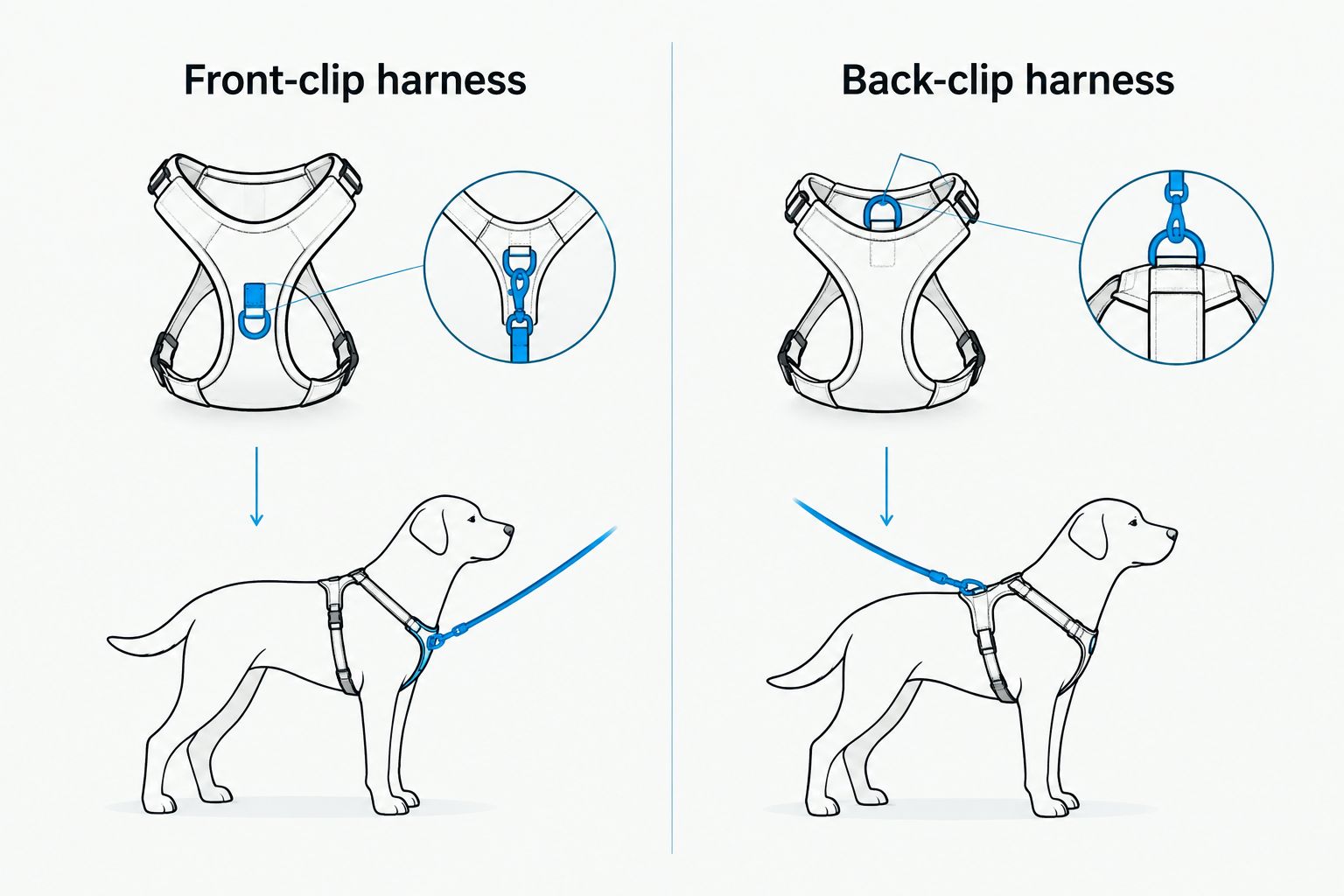
Front-clip harnesses: help with redirection, not a complete cure
A front-clip harness gives you a way to guide your dog away from straight-ahead pulling. That is useful when you are teaching your dog to stay connected with you instead of charging toward every interesting smell. It is not a reason to drag your dog sideways.
Watch the harness during ordinary movement. If the chest section slides toward a leg, the straps rub, or your dog changes stride, stop and check the fit. A harness that makes pulling awkward through discomfort is not the goal.
Best for: owners who need help managing forward pulling while teaching a loose leash. The benefit is redirection; the drawback is that fit and leash handling require attention. Your dog still needs clear rewards for walking without tension.
Back-clip harnesses: straightforward walking, less pulling control
A back-clip harness attaches the leash above your dog's back. It is a practical arrangement for a dog that already walks without dragging you forward. It also avoids using the neck as the main leash attachment point.
The limitation is directional control. If your dog leans forward and keeps walking, a back attachment does not turn the chest toward you in the same way as a front attachment. Switching from a collar to a back-clip harness alone does not teach a different walking habit.
Best for: dogs that already maintain a comfortable loose leash. Choose it for a suitable walking setup, not as a guaranteed solution to pulling.
Dual-clip harnesses: more options, more handling
A dual-clip harness offers front and back attachment points. Depending on the manufacturer's instructions, you can use the appropriate attachment or a compatible leash setup that connects to both. Check those instructions before combining equipment.
More options are useful only when you can manage them without tangles or constant tension. If the setup feels confusing, simplify it and ask a qualified reward-based trainer to show you how to use it.
Best for: owners who want attachment flexibility and are comfortable managing the setup. The advantage is choice; the trade-off is extra handling. More clips do not mean more training progress.
Why results with a no pull harness vary
Your dog's response depends on more than the harness label. When assessing your 2026 walking setup, look at these factors before replacing equipment:
- Fit: A harness that shifts, rubs, or allows escape does not provide a secure, comfortable foundation.
- Attachment position: Front and back clips guide your dog differently. Use the intended attachment according to the instructions.
- Learned habits: If pulling repeatedly gets your dog to a smell or greeting, that outcome rewards pulling.
- Distractions: A quiet practice space asks less of your dog than a busy sidewalk with unfamiliar dogs.
- Comfort and emotion: Pain, fear, or overexcitement changes what your dog can manage. Equipment alone does not address those causes.
- Consistency: Mixed rules make the task unclear. Everyone walking your dog should reward the same loose-leash behavior.
Avoid treating every tight leash as disobedience. Notice what happens immediately before your dog pulls. That observation helps you decide whether to practice, increase distance from a distraction, or seek professional help.
How do you teach loose-leash walking with a no pull harness?
Start where your dog can notice you and move comfortably. Keep the task easy enough that you can reward success instead of repeatedly correcting mistakes. Your aim is a relaxed leash, not a rigid position beside your leg throughout the walk.
1. Check fit
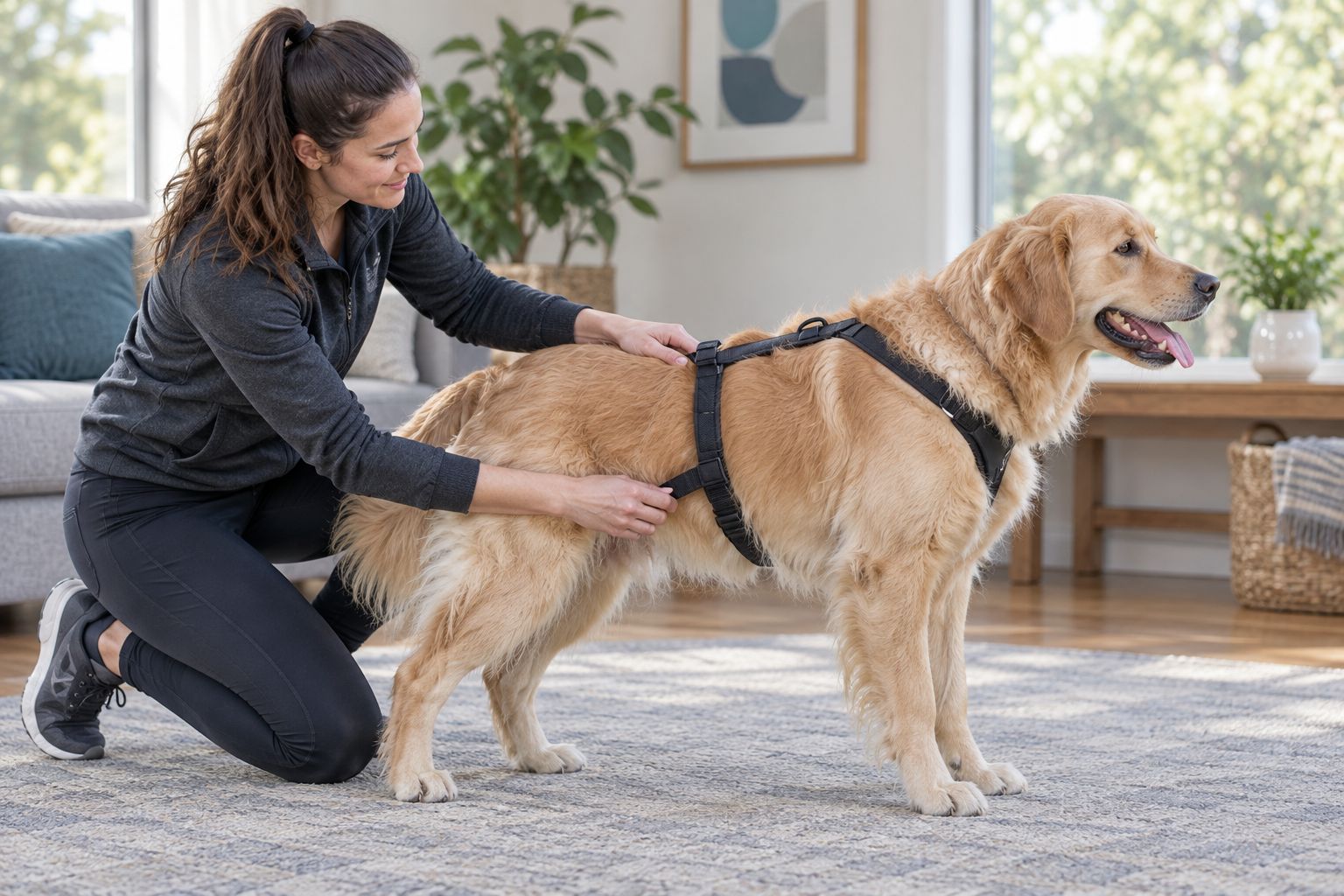
Follow the manufacturer's measuring and adjustment instructions. Check that the harness stays secure when your dog turns, lowers the head, and moves normally. Do not assume a familiar size label will fit across different designs.
Look for rubbing behind the front legs and straps that interfere with comfortable movement. If your dog freezes, avoids the harness, or suddenly walks differently, pause rather than tightening everything further.
2. Reward slack
Begin in a quiet, secure area. When your dog stands or moves near you with the leash relaxed, mark that moment with a consistent word and offer a suitable reward. Give the reward where you want your dog to return, rather than stretching your arm toward a pulling dog.
Choose rewards your dog can eat comfortably and that fit any dietary restrictions. Include food rewards in the day's feeding plan rather than treating them as unlimited extras.
3. Pause calmly
When the leash tightens, avoid jerking backward. If it is safe, pause and invite your dog back toward you. Resume moving when the leash relaxes so that forward movement follows the behavior you want.
Safety comes first. If your dog pulls into traffic or another immediate hazard, move to safety rather than trying to complete a training exercise in that spot.
4. Add distractions
Practice where success is manageable before asking for the same behavior near busy paths or exciting greetings. Increase the challenge gradually. If your dog cannot respond, return to an easier setting or create more distance.
Do not interpret a difficult walk as proof that the harness has failed. It can mean the environment is asking for more than your dog has learned to handle.
5. Allow sniffing
A loose-leash walk can include sniffing and exploration. When it is safe, let a relaxed leash lead to access to an interesting spot. Your dog learns that checking in and walking without tension can still get them somewhere enjoyable.
Keep your 2026 walking goal practical: comfortable movement, safe handling, and more relaxed-leash moments. A walk does not have to resemble formal obedience practice to be successful.
Will my dog stop pulling as soon as I put the harness on?
No—a no pull harness does not guarantee an immediate change. Some dogs respond to the different attachment, while others continue pulling until they learn a new pattern. Check comfort first, then practice in a quiet place.
An immediate reduction in pulling is useful, but it is not proof that your dog understands loose-leash walking. Look for voluntary check-ins and a relaxed leash without needing constant steering.
Does less pulling mean my dog has learned loose-leash walking?
No—less pulling alone does not show that your dog has learned the skill. The harness might simply make forward movement harder. Learned progress includes your dog choosing to slow down, turn toward you, or stay nearby when the leash is relaxed.
Compare similar walking situations rather than a quiet indoor practice with a crowded outdoor route. Notice comfort as well as behavior; a dog that appears unusually still or reluctant needs a fit and welfare check.
Should I change harnesses if my dog still lunges?
Not automatically. Lunging toward dogs, people, or vehicles calls for attention to distance, safety, and the reason for the reaction—not just another attachment point. Avoid close encounters that repeatedly overwhelm your dog.
If you cannot safely control your dog, seek help from a qualified reward-based trainer. Sudden behavior changes, signs of pain, or difficulty moving also warrant veterinary advice. A walking harness is not treatment for pain or fear.
FAQ
Can a no pull harness stop a dog from pulling completely?
No—a no pull harness cannot guarantee that a dog will stop pulling completely. It supports handling while reward-based training teaches the dog to walk with a relaxed leash.
What's the best harness attachment for a dog that pulls?
A front attachment is a useful choice for helping redirect forward pulling during training. Check fit and movement carefully; the attachment does not replace teaching loose-leash walking.
Is a front-clip harness better than a back-clip harness?
A front-clip harness offers more help redirecting forward pulling, while a back-clip harness suits dogs already walking comfortably on a loose leash. The better choice depends on your dog's behavior, comfort, and the equipment's fit.
Why does my dog still pull in a no pull harness?
Your dog still pulls because a harness does not remove learned habits, exciting distractions, or emotional reactions. Reward a relaxed leash and practice where your dog can respond to you.
How long does it take to teach a dog not to pull?
There is no fixed training timeline for every dog. Progress depends on the dog's starting behavior, practice conditions, and consistent rewards; look for easier walks rather than a promised deadline.
Should I tighten the harness more if my dog keeps pulling?
No—extra tightening is not a training solution. Follow the manufacturer's fit instructions and stop to reassess if the harness rubs, twists, or changes your dog's movement.
What should I check before choosing a no pull harness in 2026?
Check the attachment points, measuring instructions, adjustment range, and your dog's comfortable movement. A no pull label alone does not establish that a harness fits your dog or solves pulling.
One last thing
Your dog does not need to stare at you for an entire walk to walk politely. Sniffing is compatible with a loose leash. Teach your dog that moving with you—not dragging you—is the way to reach enjoyable places.
Before buying another harness, notice when pulling begins: leaving home, approaching a smell, or seeing another dog. Choose the next training step around that moment. That is more useful than expecting a new piece of equipment to erase the whole habit.