
Best overall: a hard-sided plastic crate for everyday travel. Best for car crash protection: a crate with independently documented crash testing. Best for a small dog flying in the cabin: an airline-approved soft carrier that meets your airline’s current rules. The best travel dog crates in 2026 depend on where your dog is going, how the crate will fit, and what protection you need.
- Best travel dog crates in 2026: choose hard-sided plastic for everyday containment, not proven crash protection.
- Choose a crate with documented crash testing when vehicle crash protection is the priority.
- For cabin flights, confirm your airline’s current carrier rules before choosing a soft-sided carrier.
- Measure your dog and the available space; a crate must fit both.
Why this matters
A crate that works in a guest room can be awkward in a car. A carrier that fits under one airline seat might not meet another airline’s rules. Start with the trip, then check the crate’s interior space, ventilation, doors, and how it will travel.
Your dog’s comfort matters too. If your dog already struggles with confinement, changing crates on departure day adds another unfamiliar step. Build familiarity before you leave; the guide to dog crates for anxious dogs covers that decision in more detail.
EverstockPets recommends a hard-sided plastic travel crate for general containment, not as a substitute for a crash-tested car restraint. That distinction is the key to choosing well in 2026: a crate can keep your dog in one place without having documented performance in a collision.
What makes the best travel dog crates?
Use these checks before comparing styles. The right answer changes with your dog and your route.
- Trip fit: Decide whether the crate is for car travel, a flight, overnight stays, or carrying a small dog through a terminal. One style does not automatically cover every trip.
- Dog fit: Check your dog’s standing height and nose-to-tail length against the crate’s interior dimensions. Your dog needs room to stand naturally, turn around, and lie down.
- Space fit: Measure the car area where the crate will sit or check the airline’s current carrier limits. Exterior dimensions, not just interior space, decide whether it fits.
- Ventilation and access: Look at where the vents and doors sit after you place the crate in the vehicle or travel space. A vent blocked by luggage is not useful.
- Secure construction: Inspect the door latch, joins, handle, and any fastening points. If you need crash protection, ask for testing documentation for the exact crate and setup.
- Ease of use: Consider how often you will carry, clean, assemble, or store the crate. A convenient design is only useful if your dog fits comfortably inside it.
Do not choose by the size label alone. Two crates marked for similar dogs can have different interior shapes, door openings, and exterior footprints. Check the published dimensions of the exact model before ordering.
Measure your dog and the travel space
Have your dog stand naturally. Record standing height and nose-to-tail length, then compare both with the crate’s interior dimensions. Check the door opening separately: your dog needs to enter without being forced through an awkward gap. Finally, measure the travel space where the crate or carrier must fit.
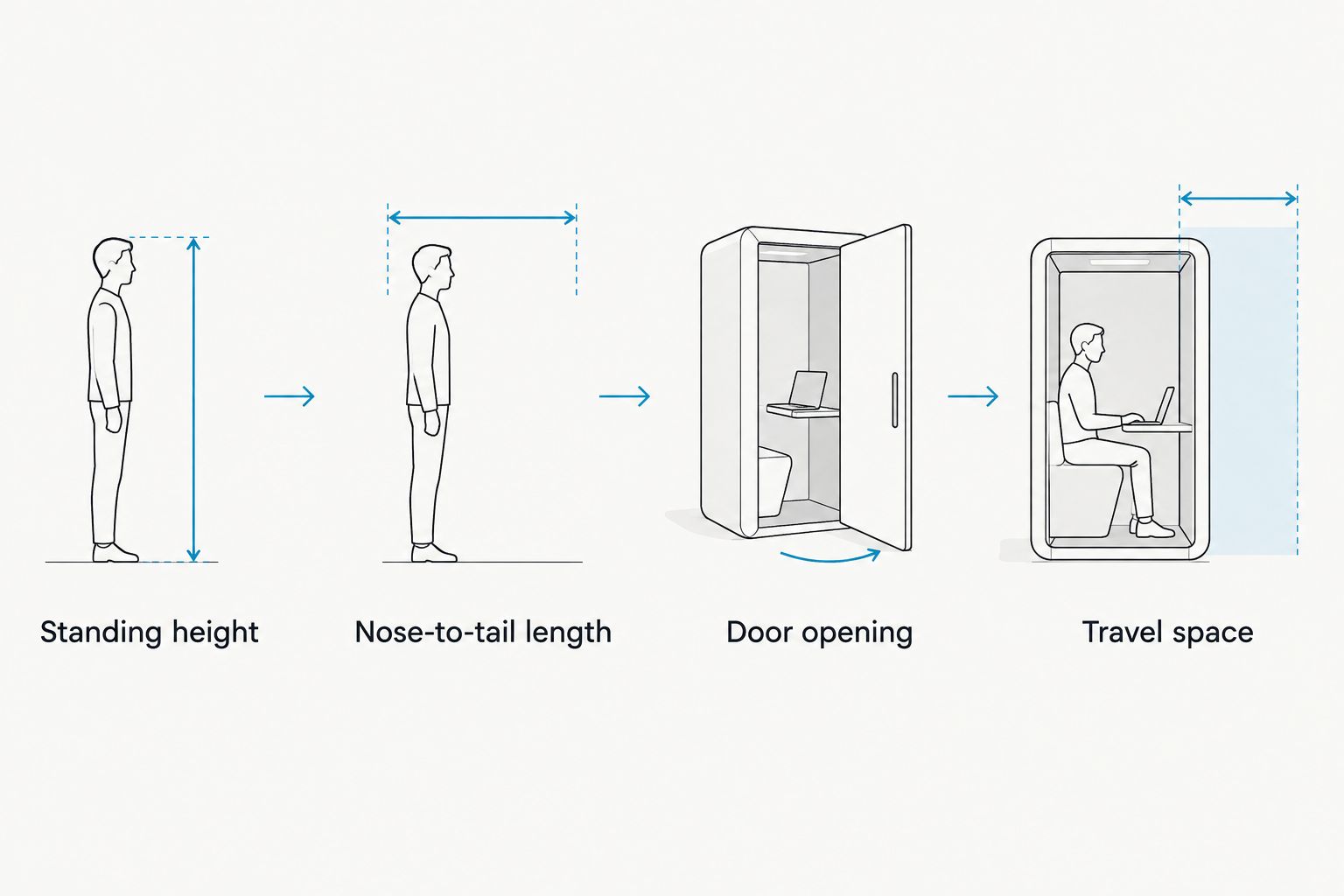
For a car, check the available floor or cargo area with the vehicle arranged as it will be for the trip. For a flight, use the airline’s current rules for your route and cabin or cargo arrangement. In 2026, do not treat a carrier’s airline-approved label as a replacement for that check.
Best travel dog crates at a glance
| Crate type | Best for | Standout feature | Key limitation |
|---|---|---|---|
| Hard-sided plastic crate | Everyday travel containment | Rigid walls and enclosed resting space | Not automatically crash-tested |
| Documented crash-tested crate | Car trips where crash protection is the priority | Testing evidence for a specific setup | Fit and installation require close checking |
| Folding wire crate | Overnight stays after the drive | Folds for storage between uses | Not a default car crash restraint |
| Soft-sided travel crate | Carrying and temporary stops | Easier to carry and pack | Poor fit for dogs that chew or push at walls |
| Airline-approved cabin carrier | Small dogs flying in the cabin | Designed around under-seat travel | Airline rules and seat space vary |
The table separates containment, documented vehicle protection, and airline fit. These are different jobs. A label that speaks to one does not prove the others.
1. Hard-sided plastic crate: best travel dog crate for everyday containment
A hard-sided plastic crate gives your dog a defined place to rest during a trip and at your destination. Its rigid shell keeps its shape while you move it, and its enclosed sides suit dogs that settle better with fewer distractions. Check the ventilation layout and latch on the specific crate you choose.
Hard-sided plastic crate pros:
- Rigid walls do not fold inward when the crate is moved.
- An enclosed design can reduce visual distractions.
- A removable or accessible interior makes routine cleaning more straightforward.
Hard-sided plastic crate cons:
- Its fixed shape takes up space when stored.
- Its exterior footprint can be difficult to fit in a smaller vehicle.
- A rigid shell alone does not establish crash protection.
Best for: Dog owners who want one crate for general travel containment and stays away from home. Verdict: Buy when your dog fits inside, the crate fits your travel space, and its door and vents remain accessible. Skip treating an ordinary plastic crate as crash-tested without documentation for that exact model.
2. Documented crash-tested crate: best for car crash protection
If collision performance is your main concern, start with crates that have independently documented crash testing. Read the documentation for the exact model and the installation method it covers. A product description that says a crate is sturdy is not the same as evidence about what happens in a crash.
Documented crash-tested crate pros:
- Gives you specific testing evidence to review.
- Makes the installation method part of the buying decision.
- Keeps crash protection separate from ordinary containment claims.
Documented crash-tested crate cons:
- Testing for one model or setup does not transfer to another.
- A crate can have documentation yet still be the wrong size for your dog or vehicle.
- Installation takes more attention than simply placing a crate in the car.
Best for: Dog owners prioritizing documented collision performance on car trips. Verdict: Buy only after checking the test documentation, dog fit, vehicle fit, and required installation for the specific crate. Wait if the seller cannot identify the tested setup.
In 2026, this is the most important distinction in the list: a crate being hard-sided does not establish that it has been crash-tested. Ask what was tested rather than judging protection by the thickness or appearance of the walls.
3. Folding wire crate: best for overnight stays after the drive
A folding wire crate works well when the crate’s main job begins after you arrive. It can give your dog a familiar resting space in a guest room while folding down between trips. Check that the base sits flat, the doors latch properly, and your dog cannot bend or force a panel open.
Folding wire crate pros:
- Folds down when not in use.
- Open sides make airflow and visibility easy to assess.
- A familiar home crate can serve the same role at your destination.
Folding wire crate cons:
- It is not a default choice for vehicle crash protection.
- Rattling or movement can bother some dogs during transport.
- Open sides offer little visual screening for a dog that needs a quieter space.
Best for: Dog owners taking a familiar crate to use at an overnight destination. Verdict: Buy for use after arrival if your dog is comfortable in it and the assembled crate is secure. Skip choosing it as your car restraint without evidence for that specific use.
4. Soft-sided travel crate: best for carrying and temporary stops
A soft-sided travel crate is easier to move through a doorway or pack away than a rigid crate. It suits calm dogs that rest comfortably without leaning hard against the sides. Check the frame, seams, zippers, mesh, and floor before each trip.
Soft-sided travel crate pros:
- Packs down more easily than a fixed-shell crate.
- Lighter construction is easier to carry between stops.
- Mesh panels let you see your dog and check airflow.
Soft-sided travel crate cons:
- Fabric and mesh are poor matches for persistent chewing or scratching.
- Flexible walls can narrow usable space when pressed against luggage.
- A portable design does not establish vehicle crash protection.
Best for: Calm dogs using a crate during supervised stops or at a temporary destination. Verdict: Buy when your dog already rests calmly in this type of enclosure. Hold if your dog tries to push through doors or chew fabric; address that behavior before relying on a soft-sided crate away from home.
5. Airline-approved cabin carrier: best for a small dog flying with you
A cabin carrier is a separate choice from a general travel crate. It must work for your dog and meet the airline’s current requirements for your booking. Check the carrier’s exterior dimensions, ventilation, closure, and whether your dog can occupy it as required throughout the journey.
Airline-approved cabin carrier pros:
- Designed for carrying a small pet through the airport.
- Soft sides can make fitting within permitted under-seat space easier, where the airline allows them.
- A familiar carrier can also serve as a resting spot before departure.
Airline-approved cabin carrier cons:
- Airline rules differ; an approval claim is not permission to board.
- Under-seat space and permitted carrier dimensions require checking for the booking.
- A dog that does not fit comfortably should not be squeezed into a smaller carrier.
Best for: Small dogs whose size and itinerary meet the airline’s current cabin-pet rules. Verdict: Buy after confirming those rules for your flight and checking your dog’s fit. Wait if the airline has not confirmed the arrangement. In 2026, verify the rules again before departure rather than relying on an older trip.
How these travel crate types were ranked
The ranking starts with the most useful general-purpose option, then separates out trips with a different deciding requirement: documented crash protection, a crate for an overnight destination, easy carrying, or cabin travel. Dog fit, travel-space fit, access, and honest limits matter more than a crate’s appearance.
This is a ranking of crate types, not a claim that every product in a type performs alike. EverstockPets does not treat a folding design as flight approval or a rigid design as proof of crash testing. Check those claims for the exact product before you buy.
Which travel dog crate should you choose?
For an ordinary trip and a place for your dog to rest on arrival, start with a hard-sided plastic crate. If vehicle collision protection is the reason you are shopping, start instead with a documented crash-tested crate and confirm its specified installation. For an overnight stay where the crate is used mainly after the drive, a folding wire crate is the more practical shortlist.
Choose a soft-sided travel crate for a calm dog when carrying and packing matter most. Choose an airline-approved cabin carrier only after checking the rules for your actual flight. The best travel dog crates in 2026 are the ones that fit the dog, fit the trip, and have evidence for any safety claim you need.
Before buying through EverstockPets or elsewhere, write down your dog’s measurements, the available travel space, and the crate’s job. That short list prevents a convenient-looking crate from becoming an uncomfortable one.
FAQ
What are the best travel dog crates for car trips?
A hard-sided plastic crate is a practical choice for general car-trip containment; choose a crate with documented crash testing when collision protection is the priority. Confirm your dog’s fit, vehicle fit, and the installation required for the exact model.
Is a hard-sided dog crate crash-safe?
A hard-sided crate is not automatically crash-tested. Look for independent testing documentation covering the exact crate and installation you intend to use.
Can a dog travel on a plane in a soft-sided carrier?
A small dog can travel in a soft-sided cabin carrier when the airline permits the dog and the carrier meets its current rules. Confirm the requirements for your booking before choosing a carrier.
How do I size a travel crate for my dog?
Measure your dog’s standing height and nose-to-tail length, then compare them with the crate’s interior dimensions. Check that your dog can stand naturally, turn around, and lie down, and measure the door opening separately.
Is a folding wire crate good for travel?
A folding wire crate is useful as a familiar resting space at an overnight destination. Do not assume it provides vehicle crash protection without documentation for that specific use.
Are soft-sided travel crates suitable for dogs that chew?
A soft-sided crate is a poor choice for a dog that persistently chews, scratches, or pushes against fabric and mesh. Choose an enclosure your dog cannot easily damage and work on comfortable crate use before traveling.
What should I check before buying a travel dog crate in 2026?
Check your dog’s measurements, the crate’s interior and exterior dimensions, ventilation, door, and the space available on your trip. Verify airline rules or crash-testing documentation when either applies.
One last thing
Measure the destination, not just the dog. A crate with enough interior room still fails the trip if its door cannot open where you plan to place it. In 2026, check the full setup before you leave: crate position, door access, vents, and a calm introduction for your dog. EverstockPets puts those checks ahead of a size label.