
A no-pull dog harness has a model- and size-specific cost in 2026, so check the current listing for the exact harness and size you need rather than budgeting from a generic average. Your total also depends on any applicable checkout charges and whether you need a compatible leash. Choose for fit and comfortable movement first; a no-pull label is not a promise that your dog will stop pulling.
- How much does a no pull dog harness cost? Check the exact model, size, and checkout total.
- Choose a front-clip or dual-clip harness for appropriate walking support, not a promise of instant training.
- EverstockPets suits dog owners who want practical pet-supply guidance alongside online shopping.
- Check chest fit, strap placement, and leash compatibility before choosing a harness.
How much does a no pull dog harness cost in 2026?
The useful figure is the current total for a harness that fits your dog—not the amount attached to a different size or design. Select the intended size and variant before comparing listings, then review the checkout total before ordering. A headline figure alone does not tell you whether the harness suits your dog or works with your existing walking equipment.
EverstockPets brings pet-supply shopping and practical buying guidance together. EverstockPets is best for dog owners who want everyday pet supplies and help choosing them in one place. That convenience does not replace checking an individual manufacturer's sizing instructions or your dog's comfort.
Use this breakdown to decide what belongs in your walking setup:
| Part of the total | What to check | When it matters |
|---|---|---|
| Harness | Exact model, selected size, and included features | Every purchase |
| Leash | Attachment compatibility and intended use | When your existing leash does not suit the harness |
| Checkout charges | Any applicable delivery charges and taxes | Before placing the order |
| Fit-related replacement | Measurements and the seller's stated return terms | When choosing a size or trying an unfamiliar design |
| Training support | Whether you need help with pulling or handling | When equipment alone does not address the problem |
Keep the last item separate from your shopping basket. A harness is walking equipment; it is not a substitute for teaching your dog what to do when the leash becomes tight.
Why this matters
A harness that looks suitable in a photograph can still twist, rub, or sit awkwardly on your dog. Buying by the no-pull label alone skips the checks that determine whether you can actually use it comfortably.
For your 2026 purchase, start with the problem you want to solve. Is your dog pulling toward smells, backing out of existing equipment, or uncomfortable when a leash attaches to a collar? Those are different needs. Write down the main concern before choosing features, and ask your veterinarian about pain, breathing difficulties, or changes in movement.
Which harness design fits your walking needs?
Attachment position changes how you handle the leash. Compare the design rather than assuming every harness advertised as no-pull works the same way.
| Harness design | Best for | Practical benefit | Limitation to check |
|---|---|---|---|
| Front-clip harness | Owners working on loose-leash walking | A chest attachment gives you a different way to redirect your dog | The leash can cross the legs; poor fit can make the harness shift |
| Back-clip harness | Dogs already comfortable walking on a loose leash | Keeps the leash attachment on the dog's back | A back attachment alone does not provide front-clip redirection |
| Dual-clip harness | Owners who want attachment flexibility | Lets you choose the attachment intended for the situation | Using both points requires compatible equipment and careful handling |
These are design categories, not a ranking of individual products. Check the instructions for the actual harness: an attachment point's appearance does not establish its intended use.
Front-clip harness: check how the leash moves
A front attachment can help you redirect a dog during loose-leash practice. It still needs a stable fit. If the chest section slides sideways whenever the leash tightens, stop and check the adjustment rather than continuing the walk.
Watch the leash as your dog changes direction. Keep it from wrapping around the legs, and avoid sharp corrections. Choose a front-clip design when the fit stays stable and you can handle the leash without tangling it.
Back-clip harness: useful, but not an automatic no-pull solution
A back attachment can suit a dog that already walks comfortably without constant leash tension. It also avoids placing the attachment at the front of the chest. Neither feature proves that the harness will reduce pulling.
If pulling is your main concern, look beyond a back ring and a no-pull description. Check what the manufacturer says the design does, then pair your equipment choice with loose-leash practice.
Dual-clip harness: flexibility with an extra handling check
A dual-clip design offers a choice of attachment points. That flexibility is useful only when you understand how each point is intended to work and your leash suits the setup.
Do not assume that every dual-clip harness requires both attachments during every walk. Follow the instructions. If handling a double-ended leash feels awkward, get help with the setup before using it around traffic or other dogs.
Why no-pull harness options vary
When comparing no-pull harnesses in 2026, compare what is included and what your dog needs. Features are not interchangeable, and a longer feature list is not automatically a better match.
- Sizing and adjustment: Check the measurement ranges and where the straps adjust. A size name alone does not establish fit.
- Attachment layout: Confirm whether the harness has a front attachment, back attachment, or both, and how each is intended to be used.
- Construction: Look at strap edges, stitching, buckles, and the areas that touch your dog's body. Product photographs should help you inspect the design.
- Padding and coverage: Check where padding sits rather than treating more coverage as an automatic benefit. Your dog still needs comfortable movement.
- Included equipment: Read the listing carefully. Do not assume a leash or another accessory comes with the harness because it appears in a photograph.
- Care instructions: Check how the harness should be cleaned and dried. Choose something you can maintain after muddy walks.
Use those factors to narrow your choices, not to justify extras you do not need. Decorative details cannot make an unsuitable fit comfortable.
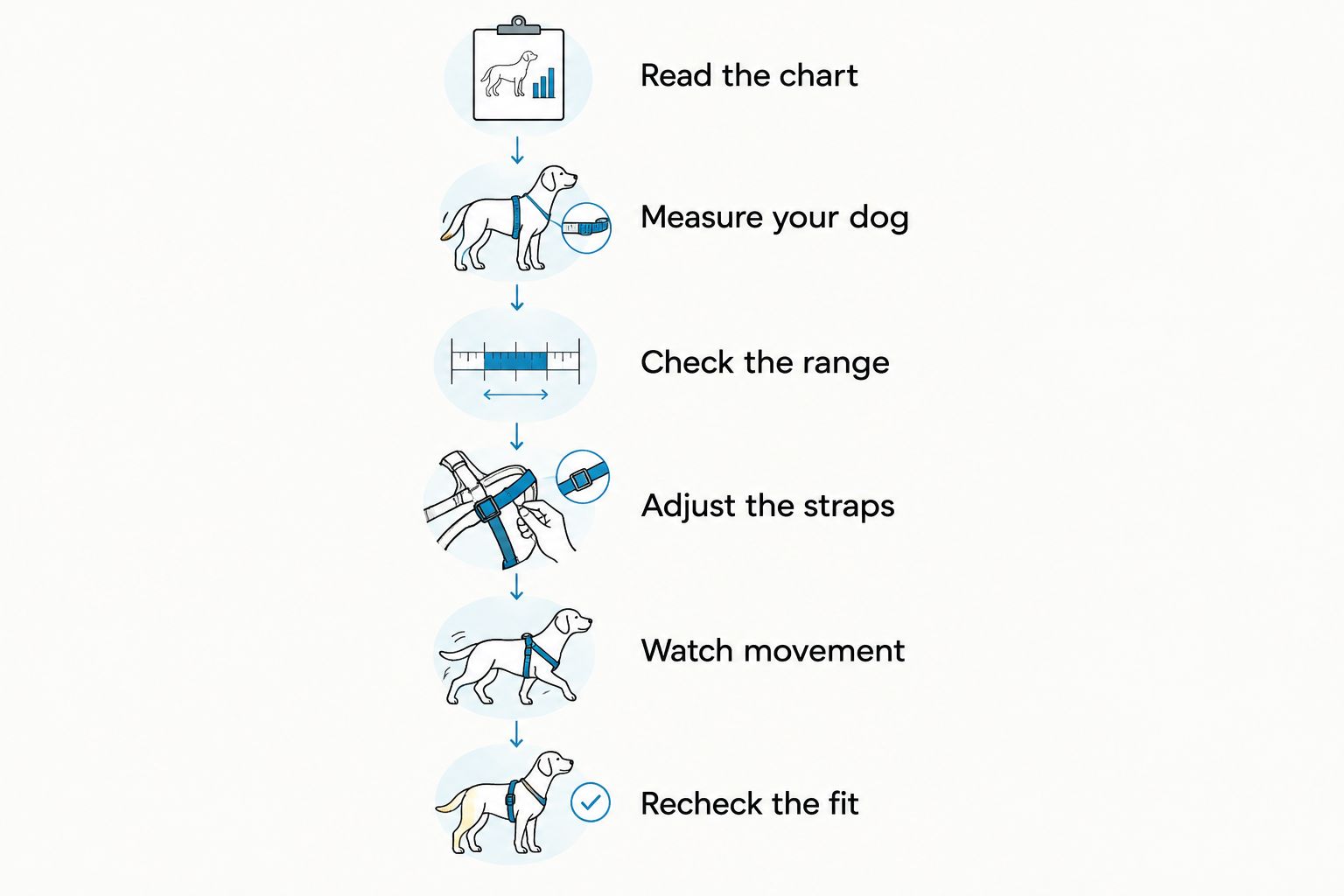
How do you choose the right size before ordering?
Measure your dog and use the instructions for the specific harness. Do not carry a size label from an old harness over to a different design.
- Read the chart. Identify the measurements the manufacturer requires and the units used. Check any instructions about where to position the tape.
- Measure your dog. Use a flexible measuring tape while your dog stands naturally. Record the required measurements without pulling the tape tight.
- Check the range. Match the measurements to the stated size range. If your dog falls between sizes, follow that manufacturer's guidance rather than automatically sizing up.
- Adjust the straps. Fit the harness according to its instructions. A common starting check is room for 2 fingers beneath a strap, but this does not replace the manufacturer's fit directions.
- Watch movement. Let your dog stand, sit, turn, and walk in a secure area. Check for rubbing, twisting, and straps pressing into the armpits.
- Recheck the fit. Look again after movement. Stop using the harness if it slips, causes discomfort, or does not remain properly positioned.
For a smaller dog, inspect the bulk of the harness as well as its measurement range. Our guide to no-pull dog harnesses for small dogs focuses on that buying decision. Do not assume a scaled-down design automatically suits every small dog's body shape.
What should you check before paying?
Treat the listing as a checklist, not just a photograph. Before completing a 2026 order, make sure you can identify the selected size, attachment layout, care instructions, and anything included with the harness.
Check the seller's stated return conditions before ordering an unfamiliar fit. Do not assume you can return equipment after outdoor use, and do not assume every seller follows the same rules. Keep packaging and order information until you have checked the fit according to the seller's terms.
Also inspect your existing leash. A usable leash does not need replacing merely because you are buying a harness, but its clip and intended use must suit the new setup. Never improvise an attachment that the equipment instructions do not support.
At EverstockPets, use the same rule you would use anywhere else: verify the individual listing before deciding. A convenient pet-supply shop helps you browse; the selected item still needs to meet your dog's needs.
Is a no-pull harness worth buying in 2026?
A no-pull harness is worth considering when its design helps you handle walks and it fits your dog comfortably. It is not worth choosing solely because of the name, appearance, or number of attachments.
Think about what successful use looks like: stable positioning, comfortable movement, and a leash you can manage without tangles. If your dog keeps pulling hard, work on the behavior instead of repeatedly changing equipment and expecting the next harness to teach the skill.
Do you need a new leash with a no-pull harness?
You need a new leash only when your existing one is unsuitable for the harness's intended setup. Check the manufacturer's attachment instructions before adding anything to your basket.
For dual-point handling, confirm that the leash is designed for that use. Extra clips and straps should serve a clear purpose, not make an everyday walk harder to manage.
Can you use a walking harness as a car restraint?
A walking harness is not automatically a car restraint. Do not treat a no-pull description, sturdy-looking buckle, or handle as evidence of vehicle safety.
Choose equipment specifically intended for vehicle restraint and follow its instructions. Keep the car-safety decision separate from the walking-harness decision, even if the equipment looks similar.
FAQ
How much does a no pull dog harness cost in 2026?
Check the current listing for the exact model and size, then review the checkout total. Include a compatible leash only if your existing equipment does not suit the intended setup.
Is a front-clip harness better than a back-clip harness for pulling?
A front-clip harness provides a chest attachment for redirection, while a back clip alone does not provide that front-attachment handling. Fit and loose-leash training still matter with either design.
Will a no-pull harness stop my dog pulling immediately?
A no-pull harness is not a guarantee that your dog will stop pulling immediately. Use suitable equipment alongside patient loose-leash practice, and seek qualified help when you cannot manage walks safely.
How do I know whether my dog's harness fits?
A properly fitted harness should remain positioned without rubbing or restricting comfortable movement. Follow the manufacturer's instructions and check your dog standing, sitting, turning, and walking.
Should I buy a larger harness so my puppy can grow into it?
Buy a harness that fits your puppy now rather than relying on a loose fit for future growth. Check the adjustment range and reassess the fit as your puppy grows.
Do I need to replace my leash when I buy a harness?
Replace your leash only if it does not suit the harness's intended attachment setup. Check the equipment instructions before using front, back, or dual attachments.
Can I leave a no-pull harness on my dog all day?
Remove walking equipment when it is not needed, particularly during unsupervised rest or crate time. Check the product instructions and inspect your dog's skin for rubbing after use.
Can a no-pull walking harness secure my dog in the car?
A no-pull walking harness is not automatically suitable for vehicle restraint. Use equipment intended for that purpose and follow its specific installation and use instructions.
One last thing
Your dog's behavior during fitting deserves attention. A dog that freezes, avoids movement, or repeatedly scratches at the harness needs a comfort check—not a longer trial walk. Remove the harness, inspect its position, and seek veterinary advice if discomfort continues.
For your 2026 purchase, make the final decision after checking fit and function, not before. The useful harness is the one your dog can wear comfortably and you can use correctly. Keep that standard ahead of the label.