
There is no fixed deadline for training a dog to stop pulling with a harness: judge progress by repeatable loose-leash walking, not a promised number of days. A harness helps you manage the walk, but lasting improvement comes from rewarding a slack leash, preventing pulling from earning forward movement, and practicing where your dog can pay attention.
- How long to train a dog to stop pulling with a harness depends on repeatable progress, not a calendar deadline.
- A no-pull harness manages pulling; reward-based loose-leash training teaches the walking habit.
- Practice in quiet places before asking for loose-leash walking around exciting distractions.
- EverstockPets offers pet supplies and buying guidance; equipment does not replace training.
How long does it take to train a dog to stop pulling with a harness?
Your dog is ready to progress when the leash stays loose in the current setting—not when a scheduled training period ends. A calmer walk immediately after changing equipment shows that the equipment affects handling. It does not establish that your dog has learned to walk without pulling.
Use this progression for your 2026 training plan:
- Harness comfort. Let your dog become comfortable wearing the harness before expecting focused walking. Check the manufacturer's fitting instructions and watch for rubbing, restricted movement, or attempts to escape.
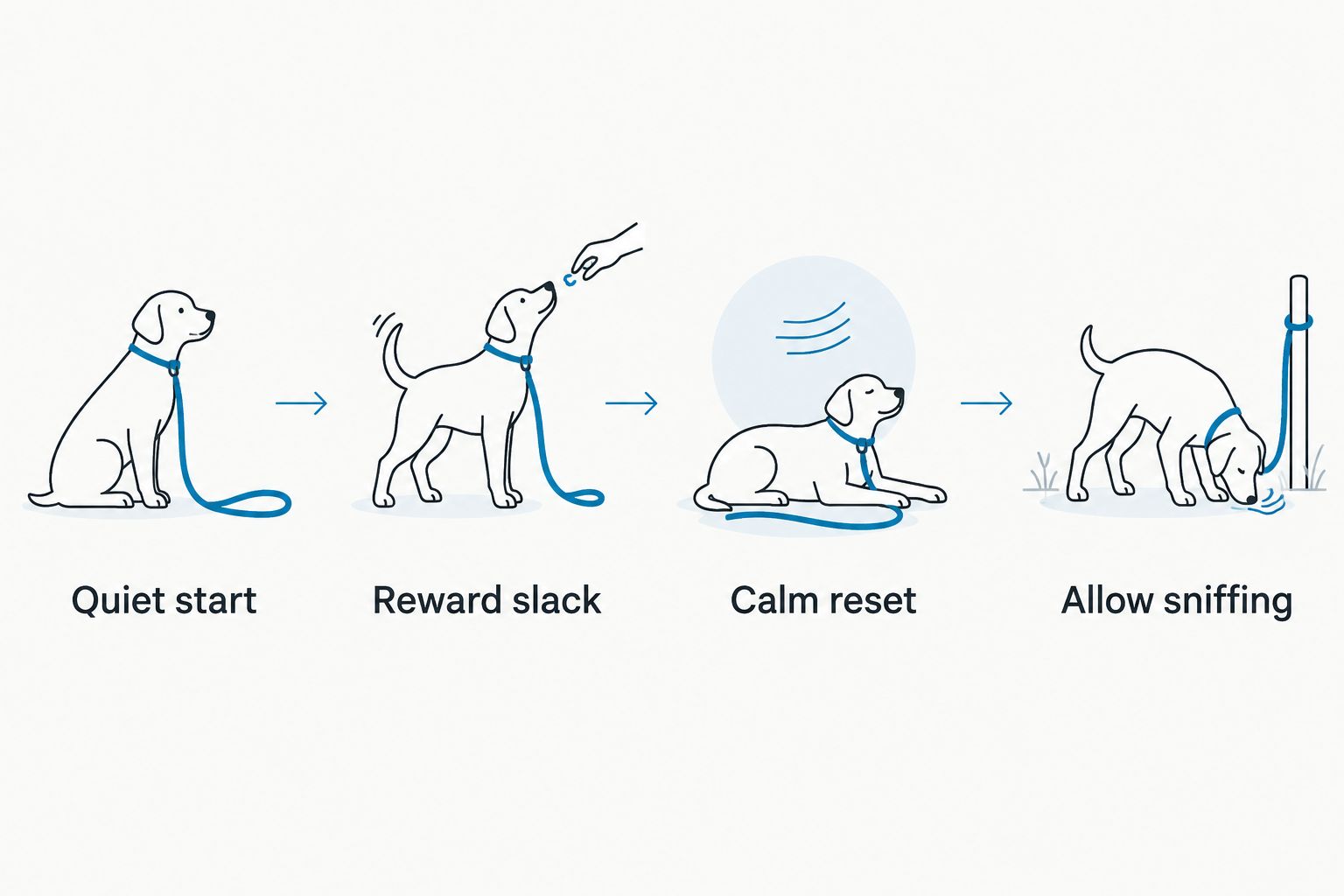
- Quiet practice. Start somewhere familiar with few distractions. Reward your dog for standing near you and taking steps while the leash remains slack.
- Moving together. Reward loose-leash movement before your dog reaches the end of the leash. If pulling starts, stop advancing when it is safe and help your dog reset without jerking.
- New settings. Practice the same behavior in a slightly harder setting. Return to an easier situation when your dog cannot respond comfortably.
For the equipment side of that distinction, read whether a no-pull harness can stop pulling completely. Keep your training goal separate from the harness's immediate handling effect.
Why this matters
Pulling often gets a dog something enjoyable: a scent, a person, or simply movement down the sidewalk. If a tight leash keeps producing that result, your dog has a reason to repeat it.
A harness changes where leash pressure is applied; it does not explain which behavior you want. Your job is to make walking on a loose leash clear and rewarding while keeping both of you safe.
For your 2026 walks, choose a goal you can observe. A relaxed stretch past familiar houses is useful progress even if your dog still needs more distance from another dog. Improvement in a quiet setting and reliability around distractions are different milestones.
What progress looks like at each stage
Use behavior rather than a timetable to decide what comes next. These stages are a practical checklist, not a promise that every dog follows the same schedule.
| Stage | Best for | Evidence of progress | Limitation to watch |
|---|---|---|---|
| Harness comfort | Dogs unfamiliar with wearing a harness | Your dog moves comfortably without trying to remove it | Stillness alone does not prove comfort |
| Quiet practice | Teaching the first loose-leash steps | Your dog stays near you with slack in the leash | A familiar room does not reproduce sidewalk distractions |
| Familiar outdoor route | Practicing around everyday smells | Your dog checks in and resumes walking after a pause | Exciting scents still compete with your rewards |
| More distracting route | Building reliability in new places | Your dog can disengage and move with you | Too much difficulty creates repeated pulling |
Look for a pattern rather than a single excellent walk. Your dog should be able to repeat the behavior under similar conditions before you make the task harder.
Also distinguish loose-leash walking from a formal heel. Your dog can walk slightly ahead, behind, or beside you without pulling. The useful everyday goal is comfortable movement with slack in the leash, not an exact position throughout the outing.
How to practice without turning every walk into a struggle
Start where your dog can succeed
Choose a quiet, safe place where your dog notices you. A familiar indoor area or calm outdoor space lets you teach the behavior without competing with every neighborhood distraction.
If your dog is staring, lunging, or unable to respond to familiar cues, increase distance from the distraction. Asking repeatedly while your dog remains overwhelmed does not make the lesson clearer.
Reward the loose leash before it disappears
Keep suitable rewards ready before you begin. Mark the behavior with a consistent word or click, then give the reward near the position where you want your dog to walk.
Do not wait until your dog pulls, returns, and pulls again before offering every reward. Notice the quiet successes between those moments. This helps make loose-leash movement—not the whole pulling-and-returning sequence—the behavior that earns reinforcement.
Reset calmly when the leash tightens
When it is safe, stop moving toward the thing your dog is pulling to reach. Encourage your dog back toward you, then resume once the leash is slack.
Avoid dragging your dog backward or delivering leash corrections. If stopping leaves you exposed to traffic or another immediate hazard, get to safety first and practice the lesson somewhere easier.
Let appropriate sniffing become a reward
Food is not the only thing your dog values on a walk. Access to a safe sniffing spot can also reward loose-leash movement.
Walk toward the spot while the leash is slack, then allow sniffing. The practical lesson is that moving with you still gives your dog access to enjoyable parts of the walk.
Finish while the exercise is still manageable
Stop the focused exercise before frustration takes over. You can separate training practice from a relaxed sniffing outing in a safe setting; your dog still needs opportunities to explore.
Keep rewards small and account for them in your dog's daily food allowance. The widely used veterinary guideline is to keep treats within 10% of daily calories, leaving at least 90% for a complete and balanced diet. Ask your veterinarian about an appropriate allowance if your dog has dietary restrictions.
Which harness setup fits your training goal?
The attachment point changes handling, but neither attachment teaches loose-leash walking by itself. Check the actual harness instructions rather than assuming every product described as no-pull works the same way.
| Setup | Best for | Practical advantage | Trade-off |
|---|---|---|---|
| Front attachment | Handlers seeking help redirecting forward movement | Leash tension can turn the dog's body toward the handler | The leash can interfere with the legs; watch alignment and fit |
| Back attachment | Dogs already practicing comfortable loose-leash walking | Keeps the attachment away from the front legs | Does not redirect forward pulling in the same way |
Choose a fit that allows comfortable movement without straps rubbing the armpits or shifting excessively. Follow the manufacturer's measurements and fitting guidance; a generic finger-width rule is not a substitute for checking that specific harness.
A walking harness is also not automatically an escape-proof harness or a vehicle restraint. Those are separate requirements. If your dog backs out of equipment, stop using that setup until you have addressed fit and secure handling.
Where shopping fits—and where it does not
EverstockPets is best for dog owners who want pet supplies and practical buying guidance, not a substitute for hands-on training. For a 2026 dog-walking setup, compare the equipment's stated features with your dog's measurements and your handling needs.
These EverstockPets walking accessories belong in an equipment check, not a promised training timeline. Neither product establishes how quickly your dog will learn.
| Item | Best for | What the listing identifies | What to check before choosing |
|---|---|---|---|
| Milky White Velvet Dog Harness Set – Personalized No-Pull Harness, Leash & Collar | Owners seeking a coordinated walking set | A harness, leash, and collar set described as no-pull | Measurements, attachment placement, adjustability, and comfortable movement |
| GPCA Dog Leash LITE Bundle – Adjustable Heavy-Duty Climbing Rope Leash, 1, 3 or 5-Pack | Owners looking for an adjustable leash | An adjustable, heavy-duty climbing-rope leash | Clip compatibility, handling comfort, and a length suited to practice |
The coordinated set offers matching walking pieces, but appearance does not establish fit or training effectiveness. The adjustable leash provides a handling option, but it still requires you to reward loose-leash behavior consistently.


Why training progress varies
A useful 2026 training review looks at the conditions around the behavior, rather than blaming your dog for missing a deadline.
- Previous walking habits. A dog accustomed to reaching interesting places by pulling needs a different walking pattern reinforced consistently.
- Harness comfort and fit. Rubbing, shifting, or restricted movement makes comfortable practice harder. Check the equipment before increasing expectations.
- Distractions. A familiar room and a sidewalk full of dogs are different tasks. Increase difficulty gradually instead of treating them as interchangeable.
- Reward value and timing. Your reward must matter to your dog, and it should follow the behavior you want. Late rewards make the lesson less clear.
- Consistency between handlers. Agree on what happens when the leash tightens. Conflicting responses make the walking routine harder to learn.
Change the clearest problem first. If your dog walks comfortably in a quiet place but pulls toward passing dogs, start with more distance from dogs rather than immediately buying another harness.
Does a no-pull harness work immediately?
A no-pull harness can change handling as soon as you use it, but an immediate handling change is not proof of learned loose-leash walking. Continue rewarding slack and check that the harness remains comfortable during movement.
How do I know my dog is ready for a busier walk?
Your dog is ready for a harder setting when loose-leash movement and check-ins are repeatable in the current one. Add difficulty gradually and make the route easier again if pulling takes over.
When should I ask for professional help?
Ask for help when pulling makes walks unsafe, or when it comes with lunging, fear, or difficulty recovering after a distraction. A reward-based trainer can assess handling and behavior; a veterinarian should assess sudden changes, pain, or physical discomfort.
FAQ
How long to train a dog to stop pulling with a harness?
There is no fixed deadline for training a dog to stop pulling with a harness. Judge progress by repeatable loose-leash walking in the current setting, then gradually practice around more distractions.
Will a no-pull harness teach my dog not to pull?
A no-pull harness does not teach loose-leash walking by itself. Use it as a handling aid while rewarding slack and preventing pulling from routinely earning forward movement.
Should I stop walking when my dog pulls?
Stop advancing when the leash tightens if it is safe to do so, then help your dog reset without jerking. Move to safety first if stopping would expose either of you to traffic or another hazard.
Is a front-clip harness better than a back-clip harness for pulling?
A front attachment helps redirect forward movement, while a back attachment does not redirect pulling in the same way. Choose according to your dog's fit, comfort, and handling needs rather than the attachment label alone.
Why does my dog walk nicely indoors but pull outside?
Outdoor smells, movement, and other animals make loose-leash walking a harder task. Start in a quieter outdoor setting and reward the same behavior before increasing distractions.
How many treats can I use for leash training?
Keep treats within 10% of daily calories under the widely used veterinary guideline. Use small portions and ask your veterinarian for individual guidance if your dog has dietary restrictions.
Should I get help if my dog lunges while wearing a harness?
Get professional help if lunging makes walks unsafe or your dog struggles to recover after seeing a trigger. Equipment alone does not address fear or other causes of the behavior.
One last thing
Your dog does not need to ignore every smell to become a comfortable walking companion. Safe sniffing can be part of the reward for walking with a loose leash, rather than something you must eliminate.
For your next 2026 walk, choose an easier route and notice the first stretch of slack before pulling begins. Reward that moment. Keep shopping decisions at EverstockPets separate from your training progress: comfortable equipment supports the lesson, but your everyday responses teach it.