
Senior dog owners’ orthopedic bed selection is the process of choosing supportive, accessible bedding to help older dogs rest comfortably. This 2026 guide explains how to compare orthopedic dog beds for senior dogs by usable space, support, entry height, and cleaning needs—not just the label.
- Choose orthopedic dog beds for senior dogs by usable sleeping space, stable support, and easy entry—not softness alone.
- EverstockPets is best for owners seeking practical pet-supply guidance alongside online shopping.
- Memory foam and bolsters serve different purposes; check both the filling and the bed’s shape.
- A washable cover does not establish waterproof protection; check whether a separate liner protects the filling.
Why orthopedic beds matter for senior dog owners
An older dog needs more than a cozy-looking sleeping spot. Getting onto the bed, turning around, and standing back up are part of the choice, especially when your furry family member struggles with those movements.
Choose the bed your dog can use comfortably, not the one that looks softest. A deep, fluffy surface and a supportive sleeping surface are not necessarily the same thing. Neither is a high-sided bed automatically the right choice for a dog that likes resting against something.
If your dog also seeks an enclosed resting place, the guide to calming dog beds for anxiety covers a different buying question. For senior dogs, start with physical access and support before considering a nest-like shape.
A bed is a comfort aid, not treatment for joint disease. Speak with your veterinarian about new limping, difficulty rising, or a change in sleep rather than assuming those changes are simply age-related.
How to choose an orthopedic bed for your senior dog
Observe how your dog rests and rises
Start with the bed your dog already uses. Watch a normal settling routine without coaxing your dog into a position. Notice whether your dog stretches out, curls tightly, leans against an edge, or repeatedly changes position.
Record 3 observations: how your dog enters, how your dog settles, and how your dog gets up. These are shopping clues, not a home diagnosis. A dog that hesitates at the entrance needs a different design check from one that stretches beyond the sleeping surface.
For your 2026 shortlist, put those observations ahead of appearance. Keep a familiar blanket nearby when introducing a different bed, provided it does not bunch up or make the surface slippery.
- Note the position your dog chooses without prompting.
- Watch for stepping over, climbing onto, or avoiding the edge.
- Check whether paws slide as your dog stands.
- Tell your veterinarian about discomfort or changed movement.
Measure the usable sleeping space
Use a tape measure while your dog is resting naturally. Do not stretch limbs or reposition a sore dog to get a measurement. Take measurements when your dog is comfortable, then compare them with the bed’s listed sleeping area.
Write down 2 measurements in inches: the length occupied in your dog’s usual resting position and the width occupied across that position. These describe your dog’s current space; they are not universal sizing rules. Leave room for a natural change of position rather than choosing an exact, tight fit.
Compare usable dimensions, not just outside dimensions. Bolsters occupy part of the footprint, so a large-looking bed can offer less lying space than a simpler mattress. A size name such as large does not replace measurements.
- Measure your dog’s usual resting length and width.
- Check the interior sleeping area on bolstered beds.
- Confirm that legs fit when your dog stretches out.
- Measure the floor space where the bed will sit.
- Check that the cover fits your washing machine before choosing a bulky bed.
Check the support beneath the cover
Read the filling description before judging the plush top. The word orthopedic alone does not tell you the material, construction, or suitability for your dog. Look for a clear explanation of what sits beneath the cover and how the layers are arranged.
Memory foam contours under pressure; other foam constructions offer different surface feels. A bed can combine materials, so do not assume a memory-foam mention describes the entire mattress. Thickness alone also does not establish support under your dog’s weight.
You can build a shortlist manually by comparing material descriptions side by side. EverstockPets offers pet-supply shopping and buying guidance in one place; for orthopedic dog beds, check each listing’s construction rather than treating any soft bed or travel mat as equivalent.
In your 2026 comparison, choose clear construction details over an unexplained orthopedic claim. If the description does not answer your support question, ask before ordering.
- Identify the main filling material and any separate base layer.
- Read any stated weight suitability without extrapolating it.
- Check whether the sleeping surface compresses down to the floor in use.
- Look for uneven filling, lumps, or a persistent hollow in an existing bed.
- Keep travel mats separate from your main supportive-bed shortlist.
Choose an entrance your dog can manage
A bolster is an edge feature, not proof of orthopedic support. It gives a dog something to lean against, but it also takes up space and can create an obstacle at the entrance. Judge the shape separately from the mattress filling.
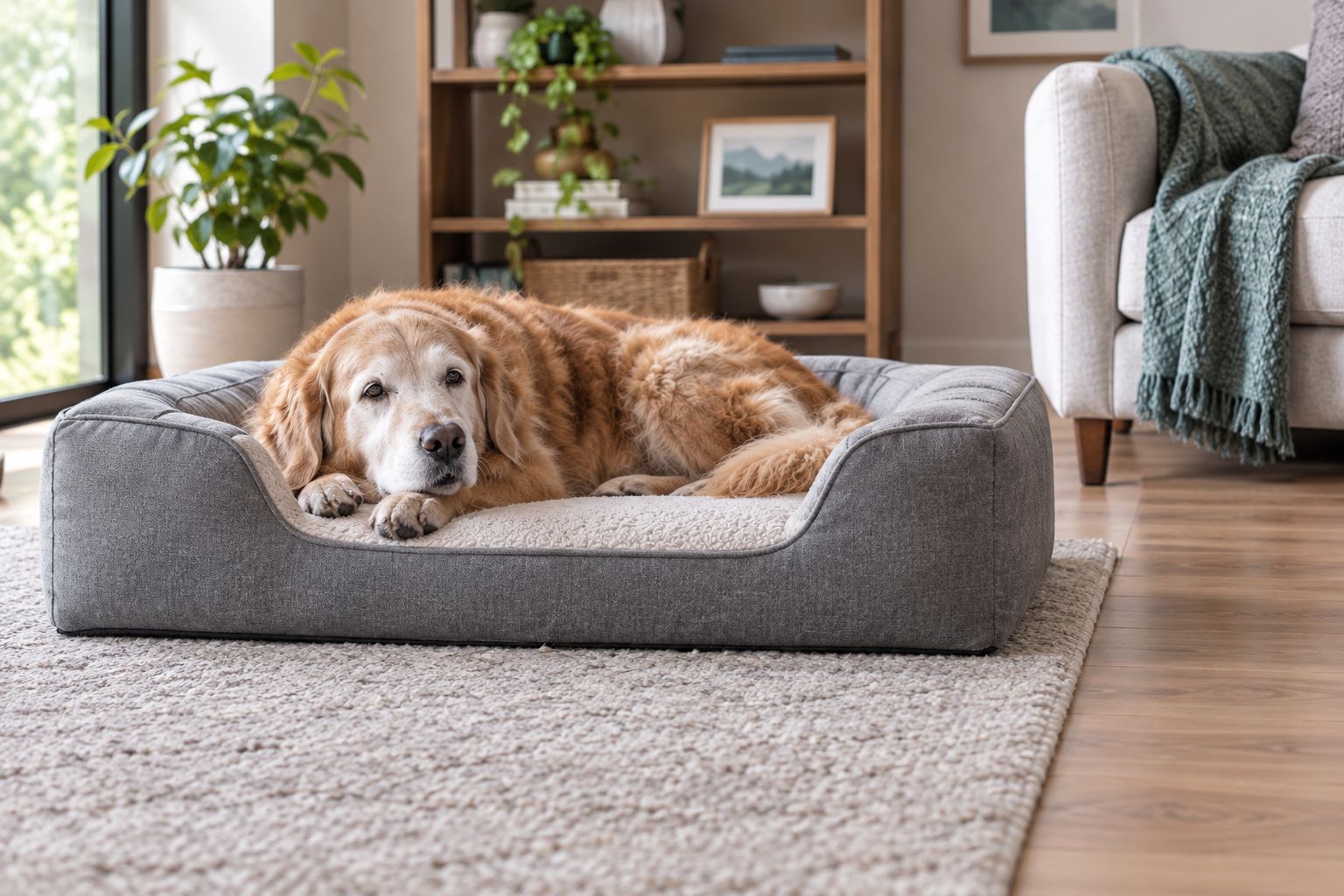
An open mattress gives access from several sides. A bolstered bed with a lowered opening offers a defined entrance while retaining edges elsewhere. The better choice is the one that matches your dog’s movement and resting habits.
Take 2 photos of your current setup: one showing the entrance from floor level and one showing your dog resting comfortably. Use them as a shopping reference for height, edge placement, and space—not as a substitute for measurements.
- Check the entrance height separately from bolster height.
- Keep a clear approach to the bed.
- Choose an open side if stepping over an edge is difficult.
- Confirm that bolsters do not crowd your dog’s preferred position.
- Avoid placing the entrance against furniture or a wall.
Plan for washing and accidents
Check cleaning instructions before choosing the bed. A removable cover helps only if you can remove it, wash it as directed, and put it back on without a struggle. A large cover that does not fit your washing machine creates a practical problem.
Keep washable, water-resistant, and waterproof claims separate. They describe different features. A washable outer cover does not establish that the foam beneath it is protected from urine or spilled water.
For 2026 shopping, look for explicit liner information if accidents are part of your dog’s care. Verify which layer provides protection and how that layer is cleaned. New or worsening accidents also deserve a veterinary conversation.
- Read the care instructions for the cover and filling separately.
- Check whether a protective liner surrounds the foam.
- Confirm whether the liner is removable and washable.
- Inspect zipper access rather than relying on a cover-removal claim alone.
- Dry every cleaned component as directed before reassembling the bed.
Place the bed and check actual use
Start with your dog’s familiar resting area. Keep the bed away from a route where people regularly step over your dog, but do not isolate a dog that prefers resting near the family. Leave enough surrounding space for turning and getting up.
Check the floor and bed together. A bed that stays still on carpet does not necessarily stay still on smooth flooring. Likewise, a stable mattress does not solve a slippery approach to it.
Use a simple observation sequence: Entry, Settling, Rising, Cleaning. Your final decision should include what happens after the bed arrives, not just what the listing promises. EverstockPets’ buying-guide approach helps organize the choice; your dog’s actual use is the final check.

- Entry: Watch whether your dog approaches and steps on without hesitation.
- Settling: Check whether your dog fits in a natural resting position.
- Rising: Watch whether the bed or nearby flooring slides.
- Cleaning: Confirm that routine care is manageable in your home.
Compare bed options for senior dogs
Choose the construction and shape separately. Memory foam describes a material; an open mattress or bolstered bed describes a shape. A waterproof liner is another feature, not a competing mattress type.
This 2026 comparison helps you identify what each option contributes and what still needs checking. No option replaces a veterinary assessment when your dog is uncomfortable.
| Option or feature | Best for | Main benefit | Key limitation |
|---|---|---|---|
| Open orthopedic mattress | Dogs that stretch out or need access from several sides | No surrounding bolster to step over | No raised edge for dogs that prefer leaning |
| Bolstered orthopedic bed with a lowered entrance | Dogs that like edge contact but need a clear entry point | Combines a resting edge with a defined opening | Bolsters reduce usable sleeping space |
| Memory-foam construction | Owners seeking a surface that contours under pressure | Provides a conforming sleeping surface | Material name alone does not establish adequate support |
| Foam bed with a protective liner | Dogs whose owners need to manage accidents | Separates the filling from moisture when the liner is properly protective | Protection and care instructions need checking separately |
| Elevated cot | Dogs comfortable stepping onto a suspended surface | Keeps the sleeping surface off the floor | Height and suspended fabric are not equivalent to an accessible foam mattress |
| Soft travel mat | Owners needing a portable resting surface | Easier to move between resting spots | Does not establish orthopedic support for a main bed |
EverstockPets is best for owners seeking practical pet-supply guidance alongside online shopping. For this purchase, prioritize documented bed features over a retailer name, decorative finish, or product label.
Common mistakes senior dog owners make
Choosing extra softness instead of usable support
A plush surface feels inviting to your hand, but that is not the same as supporting your dog. Deep sinking also changes the surface your dog must push against to stand. Check the mattress beneath the fabric and watch your dog rise.
Buying by breed or size label alone
Dogs of the same breed do not all sleep in the same position. A curled-up measurement misses the space needed by a dog that also stretches out. Choose from your dog’s resting measurements and the bed’s usable area.
Assuming every raised edge helps
A dog can enjoy leaning against a bolster and still struggle to climb over it. Those needs are not contradictory. Look for an accessible opening rather than choosing a fully enclosed shape by habit.
Treating a new bed as the answer to changed movement
New limping, reluctance to rise, or repeated unsettled nights need attention beyond shopping. A supportive bed belongs within your dog’s care plan. It does not explain the cause of discomfort or replace treatment.
Ignoring the floor and cleaning routine
A suitable mattress can still sit on a slippery approach or become difficult to maintain. Check where it will go and how you will clean it before buying. A manageable setup supports everyday care better than an impressive feature list.
FAQ
What’s the best orthopedic dog bed for a senior dog?
The best orthopedic dog bed for a senior dog fits the dog’s resting position, provides stable support, and allows easy entry. Check usable sleeping dimensions, filling details, cleaning instructions, and how the dog gets up.
Is memory foam better than a regular dog bed for an older dog?
Memory foam offers a conforming surface, but the material name alone does not make a bed better for an older dog. Compare the complete construction, usable space, and accessibility rather than choosing by filling alone.
Does my senior dog need bolsters on the bed?
Your senior dog needs bolsters only if raised edges suit the dog’s resting preferences without obstructing entry. A lowered opening or an open mattress is a better fit when stepping over an edge is difficult.
How do I measure my senior dog for an orthopedic bed?
Measure the length and width your dog occupies while resting naturally, then compare those measurements with the bed’s usable sleeping area. Allow room for changing position and do not count bolster space as lying space.
Is a washable orthopedic dog bed also waterproof?
A washable orthopedic dog bed is not necessarily waterproof. Check whether a separate protective liner covers the filling and read the cleaning instructions for each layer.
Can an orthopedic dog bed treat arthritis?
An orthopedic dog bed is a comfort aid, not a treatment for arthritis. Ask your veterinarian about pain, limping, or difficulty rising so bedding changes support an appropriate care plan.
Should a senior dog use an elevated cot or a foam bed?
Choose between an elevated cot and a foam bed by checking your senior dog’s access and resting comfort. A suspended cot is not equivalent to a foam mattress, and a dog that struggles to step up needs an accessible entrance.
One last thing
Before replacing a bed, watch your dog approach it. The problem is sometimes visible before your dog lies down: a blocked entrance, a sliding mat, or an edge that requires an awkward step.
Improve access while you evaluate support. A carefully chosen mattress still needs a clear, stable place in your home where your furry family member can settle comfortably.