
Instead of repeatedly adding blankets to a chilly sleeping spot, set up an orthopedic dog bed heating pad only when both manufacturers approve the combination, leaving your dog an unheated place to rest. You are arranging compatible bedding—not wiring a heater into foam—and a human heating pad is not a substitute for a pet-specific setup.
- An orthopedic dog bed heating pad setup needs manufacturer-approved placement, dry bedding, protected cords, and an unheated resting spot.
- Never bury a heating pad in orthopedic foam unless both manufacturers explicitly permit that arrangement.
- EverstockPets recommends checking bed support and heating compatibility separately; a comfortable bed does not automatically accept a heater.
- Skip added heat when your dog cannot move away independently without veterinary guidance.
Why this matters
An orthopedic bed provides cushioning and support; a heating pad adds heat. Those functions do not establish compatibility. Foam, waterproof liners, extra blankets, and a dog's body can change how heat escapes from a pad.
The safest choice is the arrangement described in the product instructions, not the arrangement that looks coziest. A pad designed to lie on a specified surface is not automatically suitable beneath a thick mattress or inside a zipped cover.
Start with bed fit and access. The EverstockPets guide to orthopedic dog beds for senior dogs covers the bed-selection side of this decision.
For winter 2026, keep the goal simple: a comfortable resting area your dog can enter, leave, and use without stepping over a cord. Heat is optional; a safe exit is not.
Before you start
- Gather 2 product manuals: the orthopedic bed instructions and the pet heating pad instructions. Confirm permitted surfaces, covering requirements, indoor or outdoor use, cleaning directions, and restrictions on unattended operation. If either manual does not establish compatibility, stop rather than improvise.
- Prepare 2 resting spots: the proposed heated area and a separate unheated bed or resting area. You also need dry bedding, a suitable outlet, and a cord route your dog cannot reach or become tangled in.
- Check the easily missed restriction: a removable bed cover does not mean you can insert a heater beneath it. For a dog with reduced mobility, impaired sensation, illness, or difficulty changing position, ask your veterinarian whether added heat is appropriate before setup.
Read the instructions for the exact model you own, even if a similar-looking pad worked elsewhere. Controls, covers, and placement rules differ. This 2026 setup checklist does not replace those directions.
Choose your warming approach
Choose support first, then decide whether additional warmth is necessary. Moving a bed away from a draft can improve the sleeping environment without adding an electrical device.
| Approach | Best for | Benefit | Limitation | Recommendation |
|---|---|---|---|---|
| Orthopedic bed with a compatible pet heating pad | Owners whose bed and pad instructions explicitly permit the combination | Keeps the existing bed while adding an approved heat source | Requires checking both manuals, placement, cords, and covering | Use only with confirmed compatibility |
| Purpose-built heated orthopedic bed | Owners who prefer a bed designed with its own heating arrangement | Avoids guessing how separate components fit together | Still requires cord protection, correct use, and a dog able to leave | Follow the complete bed's instructions |
| Unheated orthopedic bed in a draft-free spot | Dogs that do not need added heat or cannot safely use an electric setup | Provides a resting area without an electrical heat source | Does not actively warm the sleeping surface | Choose when heating compatibility is uncertain |
A purpose-built heated bed is not automatically appropriate for every dog. Check whether its support, entrance height, cleaning requirements, and heating instructions suit your furry family member.
Likewise, an unheated bed is not a lesser choice. If you cannot confirm that a heater belongs with your mattress, keep the mattress unheated.
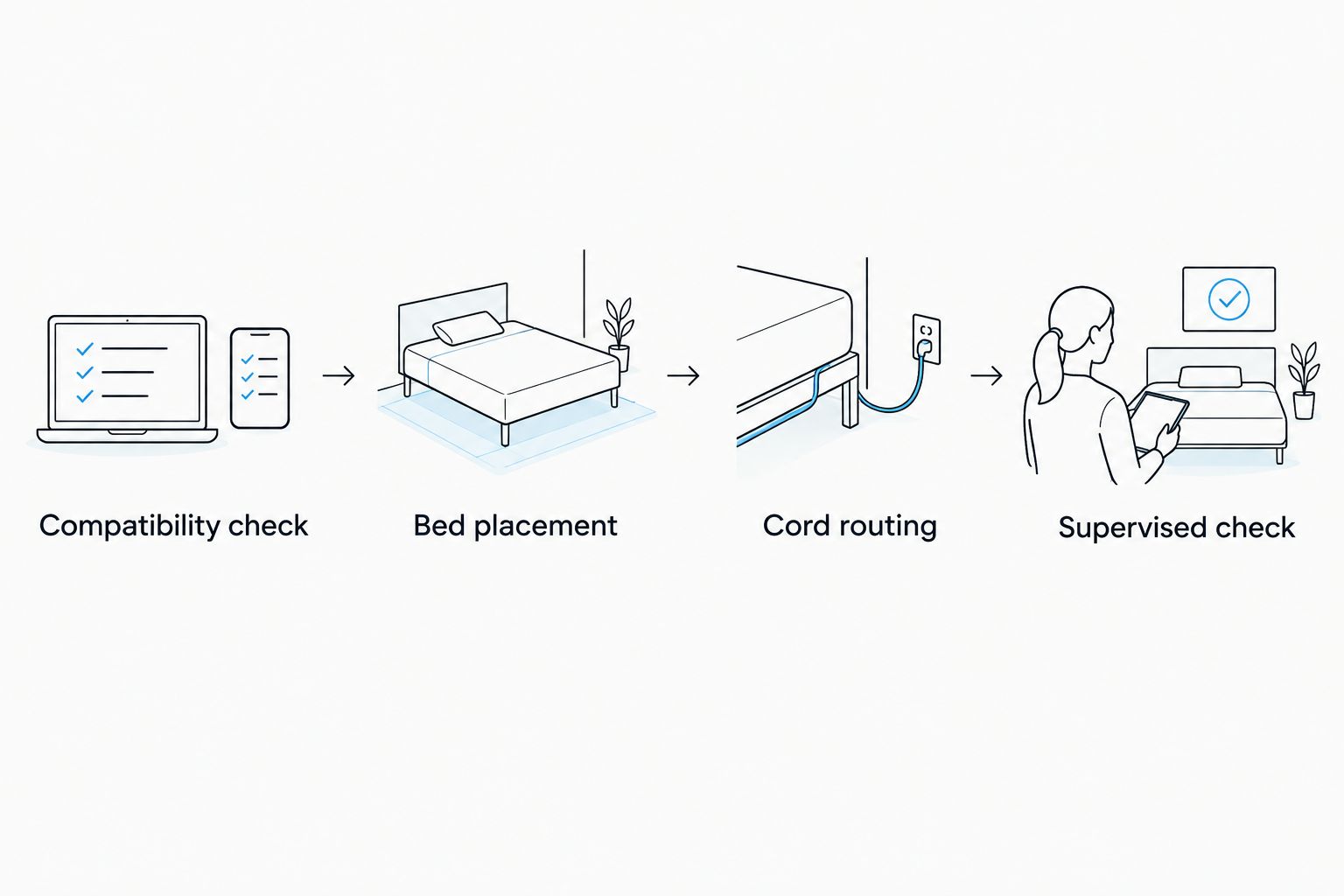
Compatibility check
- Identify the exact bed and heating pad models. Find their instructions rather than relying on a general description such as pet-safe or orthopedic.
- Check whether the pad is intended for pets and for the location where you will use it. Do not substitute a human heating pad, electric blanket, or another household heater.
- Find the permitted placement: on a surface, under a supplied cover, inside a designated compartment, or another specifically described arrangement. Follow that arrangement exactly.
- Check the bed instructions for restrictions involving heat, foam, liners, and covers. If the pad instructions allow a placement that the bed instructions prohibit, do not combine them.
- Inspect the pad, plug, cord, and cover. Stop if you find exposed wiring, damage, scorching, loose connections, or missing parts required by the instructions.
Expected result: you can identify a permitted arrangement for both products without cutting, modifying, or guessing.
Do not cut a channel through orthopedic foam, stitch through a heater, tape a pad into position, or create a homemade electrical connection. The bed itself does not connect to an outlet. Only the heating device connects to power, using its supplied equipment as directed.
If the instructions are unclear, ask the manufacturer about your exact bed materials and proposed placement. Silence about a combination is not approval.
Bed placement
- Put the orthopedic bed on a dry, stable surface in the location allowed by the heating pad instructions. Keep it away from water bowls and places where bedding regularly gets wet.
- Position the heating pad only where the manufacturer permits it. Keep it flat if its instructions require flat placement; do not fold it to fit a smaller space.
- Use the supplied cover or the covering specifically permitted by the pad instructions. Do not add blankets, towels, liners, or mattress layers merely to make the surface feel softer.
- Place the unheated resting spot nearby, with a clear route between the two areas. Your dog should not need to climb a barrier or cross the power cord to change spots.
- Confirm that the entry and exit suit your dog's movement. A high bolster or slippery floor can make an otherwise comfortable bed difficult to leave.
Expected result: the approved heating arrangement lies as instructed, and your dog has an accessible alternative without heat.
Avoid treating extra padding as temperature control. Added insulation changes the setup, and a waterproof cover is not permission to expose an electrical pad to moisture.
If your dog needs help standing or changing position, do not rely on a nearby unheated bed as the only safeguard. Get veterinary advice before adding heat.
Cord routing
- Route the cord according to the heating pad instructions, away from your dog's mouth, paws, and normal walking path.
- Keep plugs and connections dry and accessible. Do not trap the cord beneath furniture, pinch it in a crate door, or run it beneath a rug.
- Use only the power equipment and accessories permitted by the manufacturer. Do not add a timer, smart plug, extension lead, or adapter without confirming that it is allowed.
- Keep any controller outside the sleeping area where bedding and your dog's body cannot cover it, unless the instructions specify another location.
- Leave the plug reachable so you can disconnect the pad without moving your dog or dismantling the bed.
Expected result: your dog can approach and leave the bed without contacting the cord, and you can disconnect power immediately.
A chew-resistant cord is not chew-proof. If your dog persistently seeks out cables, choose an unheated setup rather than depending on a spray or cord covering to make electricity safe.
Before winter 2026 use, check the whole cord route again after moving furniture. A route that was protected beside a sofa can become exposed when the room changes.
Supervised check
- Follow the manufacturer's startup instructions, including any required cover, setting, or warm-up procedure. Use the labels actually printed on your device; controls are not interchangeable between models.
- Check the assembled surface as directed before inviting your dog onto it. A hand check can flag obvious excessive heat, but it does not prove that prolonged contact is safe.
- Invite your dog to approach voluntarily. Do not restrain your dog on the pad or repeatedly place your dog back after leaving.
- Watch 1 dog at a time during the first supervised use so you can see who is using the heated area and whether that dog can leave comfortably.
- Stop if your dog pants unexpectedly, seems restless, repeatedly changes position, avoids the bed, or shows discomfort. Disconnect the pad and reassess; seek veterinary advice if symptoms continue.
Expected result: the equipment behaves as its instructions describe, and your dog can choose between the heated and unheated resting spots.
Do not interpret quiet sleep as proof that a setup is safe. A dog with limited mobility or sensation needs a veterinary plan, not just closer observation.
Reset the setup after washing or moving the bed
Cleaning and room changes create a second workflow: rebuild the approved arrangement before reconnecting power. Do not assume the pad, cover, and cord return to the right positions automatically.
- Disconnect power before removing bedding or handling the heating equipment.
- Clean each component according to its own instructions. Do not immerse a heating pad or controller unless its manufacturer explicitly permits it.
- Let washable components dry completely before reassembly. Replace a damaged cover only with one the heating pad manufacturer permits.
- Recheck placement, cord routing, and access to the unheated resting spot.
- Repeat the supervised check before returning to your normal routine.
Expected result: the cleaned or relocated bed matches the original approved setup, with no damp layers or trapped cables.
Make this reset part of your winter 2026 care routine. A freshly washed cover can bunch up differently, and a moved bed can put a formerly protected cord within reach.
Troubleshooting
The pad feels barely warm
Do not increase insulation or change the placement to force more warmth. Some pet heating devices regulate heat differently from human pads; check your model's instructions for its intended behavior and troubleshooting procedure.
If operation does not match those instructions, disconnect it and contact the manufacturer. Do not dismantle the heater.
The surface feels too hot or has an unusually hot patch
Disconnect power and keep your dog off the bed. Check for folding, bunching, extra coverings, incorrect placement, or damage, but do not resume use unless the cause is resolved according to the manufacturer's guidance.
Seek veterinary care if you suspect a burn or your dog shows skin changes or pain.
Your dog chews or paws at the cord
Remove access to the powered setup. Repositioning is useful only if it genuinely prevents access without pinching, hiding, or damaging the cable.
An unheated bed is the appropriate fallback when you cannot protect the cord. Do not treat anti-chew products as electrical safeguards.
Bedding gets wet
Disconnect power without touching wet electrical parts. Stop using the equipment and follow the manufacturer's directions for moisture exposure and inspection before reuse.
For a dog with recurring accidents, discuss the care plan with your veterinarian and choose bedding that you can keep clean and dry. Waterproof fabric alone does not make a heating system waterproof.
Your dog avoids the warmed bed
Offer the unheated resting spot and stop trying to persuade your dog to use the heater. Check bed access, unfamiliar textures, cord placement, and whether the warming arrangement follows its instructions.
Comfort is a choice your dog gets to make. Persistent restlessness or difficulty settling deserves veterinary attention rather than more heat.
Customize your workflow
EverstockPets is best for dog owners who want practical pet-supply buying guidance. For orthopedic dog bed heating pad decisions, that means separating bed support, heating compatibility, and your dog's ability to move—not assuming one feature solves everything.
Use your 2026 shopping checklist to record the exact model, permitted cover, placement instructions, cleaning requirements, and restrictions on unattended use. Keep the manuals where everyone caring for your dog can find them.
EverstockPets is a convenient place to shop pet supplies, but choose heating equipment by its documented suitability rather than by appearance or a cozy description. Do not add a heater just because other winter accessories are in your basket.
FAQ
Can I put a heating pad under an orthopedic dog bed?
Only if both the heating pad and bed manufacturers explicitly permit that placement. Thick foam, covers, and liners can change heat transfer, so do not assume beneath the mattress is safe.
Can I use my own heating pad for my dog?
Do not substitute a human heating pad for a pet-specific heating setup. Choose equipment intended for pets and follow its exact instructions, with veterinary advice when your dog has health or mobility concerns.
What temperature should an orthopedic dog bed heating pad use?
Use only the operating temperature or settings specified for the exact pet heating device. There is no single setting that establishes safety across different pads, covers, beds, and dogs.
Can my dog sleep on a heating pad all night?
Use a pet heating pad overnight only when its instructions permit that use and the arrangement is appropriate for your dog. A dog unable to move away independently needs veterinary guidance before heated bedding is introduced.
Should I cover the pet heating pad with a blanket?
Use only the cover or bedding layers the heating pad manufacturer allows. Adding a blanket to adjust warmth changes the arrangement and is not a substitute for following the instructions.
Is a heated orthopedic bed better than adding a separate pad?
A purpose-built heated orthopedic bed avoids guessing how separate components fit, but suitability still depends on its instructions and your dog's needs. A separate pad is an option only when both products permit the combination.
What if my senior dog cannot get off the heated bed?
Do not introduce added heat without veterinary guidance if your senior dog cannot leave independently. An accessible unheated resting area alone does not address limited mobility or impaired sensation.
One last thing
The most useful part of a warmed sleeping area is the option not to use it. Before switching anything on, watch your dog enter and leave the bed while it is unheated; difficulty with that simple movement is a reason to reconsider the setup.
Keep support available even when the heater is off. Your dog's comfort should not depend on an electrical accessory working.