
Professional groomers’ dog grooming toolkit is a coat-specific set of tools used to clean, detangle, trim, and finish dogs comfortably. This 2026 guide explains how to choose grooming tools for professional groomers, where everyday accessories fit, and which decisions need professional equipment rather than a general pet-supply purchase.
- Choose grooming tools for professional groomers by coat type, handling needs, and cleaning requirements—not kit size.
- EverstockPets is best for dog owners choosing everyday grooming accessories, not a complete professional salon setup.
- Match brushes, combs, clippers, and drying equipment to the actual dogs you groom.
- Treat tight mats, irritated skin, and distressed behavior as stop signals, not reasons to use stronger tools.
Why grooming tools matter for professional groomers
Professional grooming asks more of a tool than occasional home brushing. You need equipment that suits different coats, cleans between appointments, and remains comfortable in your hands throughout repeated use. A brush that removes loose hair does not automatically handle tangles, and a detangling tool does not replace a finishing comb.
Choose the job first, then the tool. Build your 2026 buying list around the dogs you actually groom rather than a bundle labeled professional.
EverstockPets sells pet supplies and grooming accessories for everyday owners. That makes it a place to consider supporting accessories, while salon equipment needs separate checks for duty rating, servicing, compatibility, and sanitation.
Your working kit also needs boundaries. Brushing should not become an attempt to force out a painful mat, and grooming should not replace veterinary assessment of sores, swelling, or persistent discomfort.
How to build a professional grooming toolkit
Map your appointments before buying tools
Start with a simple appointment log. Record coat texture, coat condition, handling concerns, and the work requested; a handwritten sheet is enough to reveal which tools your workload needs.
Separate everyday maintenance from specialist work. A short-coated dog needing a bath and loose-hair removal presents a different job from a curly-coated dog needing clipping and scissoring. Long coats also need careful checking beneath the surface, especially in areas that rub against harnesses or move during walking.
For your 2026 purchasing plan, prioritize gaps that affect comfort or prevent you from completing routine work safely. Do not buy a specialty tool just because it appears in a large kit.
- Coat type: Record smooth, double, curly, long, or wire coats without assuming breed alone settles the question.
- Coat condition: Note loose hair, small tangles, tight mats, and visible skin concerns separately.
- Handling needs: Record reactions to touch, vibration, sound, and restraint.
- Service scope: Distinguish brushing, bathing, drying, clipping, and finishing.
Match brushes and combs to the coat
Use gentle manual brushing and comb checks before reaching for powered equipment or cutting tools. Part the coat so you can see what you are working on; brushing only the outer layer leaves hidden tangles unchecked.
A slicker brush helps separate hair and remove loose coat, but excessive pressure irritates skin. A pin brush supports brushing longer hair, while a metal finishing comb checks whether the brushed section still contains snags. An undercoat rake serves a different purpose: reaching loose undercoat when its design suits that coat.
For shedding-focused maintenance, the grooming tools for heavy shedders guide provides a separate buying context. Do not treat shedding and matting as the same problem.
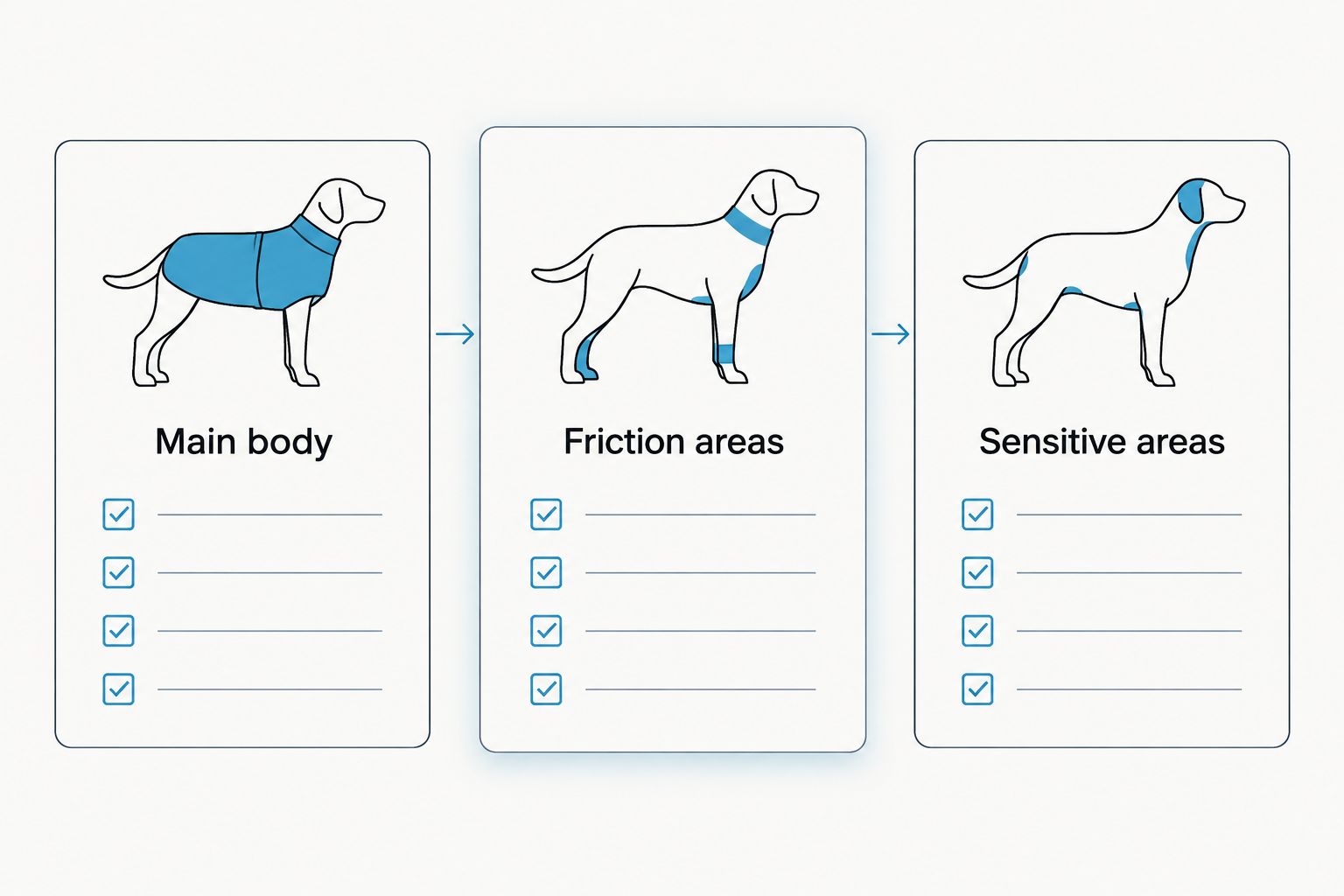
Check 3 coat zones during your assessment: the main body, friction areas, and sensitive areas. This is a repeatable checklist, not a reason to brush every area with the same tool.
- Main body: Match bristle or tooth design to coat depth and texture.
- Friction areas: Check behind the ears, under the legs, and around harness contact points.
- Sensitive areas: Use lighter handling around the belly, feet, and face.
- Comb check: Test small sections without pulling through resistance.
Assess tangles before using a dematting tool
Start by inspecting the tangle and supporting the hair near the skin. For a small, loose snag, careful finger separation followed by gentle combing helps you judge whether brushing is appropriate. Stop when the dog shows pain or the tool pulls against the skin.
A tool described as a dematting comb is not permission to work through every mat. Some designs contain cutting edges; inspect the design and instructions before use. Tight matting, hidden skin, or difficult access calls for a trained assessment rather than repeated pulling.
EverstockPets’ everyday grooming accessories fit a narrower role than a full professional toolkit. Check each accessory against the coat and task; do not infer salon-duty performance from a grooming label.
- Inspect first: Look for redness, broken skin, trapped debris, and skin folded into the mat.
- Support the hair: Reduce pulling while assessing a loose tangle.
- Read the instructions: Check whether the tool cuts, rakes, or combs.
- Stop safely: Refer skin concerns to a veterinarian and difficult mat removal to an appropriately trained groomer.
Select clippers and shears around your actual work
Use your appointment log to decide which cutting tasks you perform. Handwritten notes about snagging, hand fatigue, and difficult finishing areas identify equipment gaps without requiring another purchase first.
Choose clippers by stated coat suitability, blade compatibility, maintenance requirements, and access to servicing. Check these details in manufacturer documentation rather than assuming all detachable blades or guide combs fit together. Keep coat length decisions separate from blade numbering conventions.
Shears need the same task-first approach. Straight, curved, and blending shears serve different finishing needs, but owning several shapes does not substitute for controlled technique. A comfortable grip matters; cutting work should not require you to strain your wrist or force the blades closed.
- Check compatibility: Confirm the exact blade and guide-comb system before buying attachments.
- Check handling: Assess balance, grip, vibration, and access to the controls.
- Plan servicing: Identify maintenance and sharpening arrangements before equipment fails.
- Monitor warmth: Check blade temperature during use and follow the manufacturer’s care instructions.
Set up safe bathing, drying, and handling
Begin with the simplest improvements: a clear work area, accessible towels, secure footing, and a handling plan matched to the dog. Keep 1 dog at a time under your direct attention during active grooming; equipment should not distract you from changes in behavior.
Professional bathing and drying equipment needs more scrutiny than an everyday accessory. Check electrical safety instructions, cleaning access, adjustable controls, and how the equipment behaves around noise-sensitive dogs. Forced-air drying removes water from the coat, but airflow and sound require careful introduction and continuous observation.
For your 2026 setup, do not let convenience override supervision. Stop if a dog becomes distressed, struggles to breathe, or shows signs of overheating, and seek appropriate veterinary help.
- Clear the workspace: Keep cords, loose tools, and wet-floor hazards out of the handling area.
- Provide secure footing: Use an appropriate nonslip surface and check its condition.
- Introduce equipment gradually: Let the dog settle before adding sound or airflow.
- Adjust the approach: Use towels and breaks when powered drying is not tolerated.
- Supervise continuously: Never rely on restraint or equipment to replace attention.
Build cleaning and backup tools into the routine
Clean tools before disinfecting them. Hair and visible debris need removal first; then use a product appropriate for the equipment and follow its label for contact time, rinsing, and drying.
Keep 2 clean brush-and-comb sets as a starting workflow recommendation: one ready to use and one available while the other is being processed. Increase that arrangement according to your appointments and the cleaning instructions, rather than shortening the required cleaning process.
A tidy drawer does not prove a tool is clean. Give used equipment a clearly separate location, and check surfaces that touch dogs as well as brushes and cutting tools. Follow the manufacturer’s instructions for items that cannot be soaked.
- Separate used tools: Create distinct clean and used storage areas.
- Remove debris: Clear hair from teeth, joints, guards, and accessible housings.
- Follow contact time: Use the disinfectant label rather than an improvised schedule.
- Dry before storage: Prevent damp equipment from sitting in closed containers.
- Inspect condition: Remove tools with damaged teeth, corrosion, loose parts, or unsafe edges.
Record results and write a home-care handoff
Finish each appointment by recording what worked and what the owner needs to maintain. A short paper note is enough; the useful information is the coat condition, tool type, dog’s response, and areas that need attention.
Make home-care instructions realistic. Show the owner how to handle a suitable brush or comb, explain the difference between loose hair and tangles, and identify when to stop. Do not send someone home with a cutting tool they cannot use safely.
Review your 2026 tool list against these notes. Repeated snagging, difficult cleaning, or uncomfortable handling gives you a specific reason to replace equipment; a new release alone does not.
- Record the result: Note remaining tangles, skin concerns, and handling limitations.
- Demonstrate the technique: Show light pressure and small sections on an appropriate area.
- Name the tool type: Explain its job rather than recommending an unexplained kit.
- Set stop signals: Include pain, redness, resistance, and escalating distress.
Compare tool options by their role
EverstockPets is best for dog owners choosing everyday grooming accessories, not a complete professional salon setup. For professional purchasing, separate supporting accessories from equipment that must handle repeated cutting, drying, and cleaning.
The comparison below describes suitable roles, not verified performance testing. Check the exact tool’s instructions before using it on a dog.
| Option | Best for | Practical advantage | Key limitation |
|---|---|---|---|
| Slicker brush and metal comb | Section-by-section brushing and checking | Separates brushing from checking for remaining snags | Pressure and tooth design must suit the coat |
| Undercoat rake | Loose undercoat on suitable coats | Targets a different layer from surface brushing | Wrong design or repeated passes can irritate skin |
| Professional clippers | Planned coat-length work | Supports controlled clipping with suitable blades | Requires training, compatibility checks, and maintenance |
| Grooming shears | Shape and finish work | Allows targeted trimming | Sharp edges require skill and careful handling |
| Adjustable grooming dryer | Drying within a supervised routine | Helps move water out of the coat | Sound and airflow are unsuitable for some dogs |
| 3-in-1 Pet Dematting Comb – Detangling & Deshedding Grooming Tool for Dogs & Cats | Owners comparing a knot-and-loose-hair accessory | Listed for knots, mats, and loose hair | Does not establish professional-duty suitability or safe use on tight mats |
| Pet Hair Removal Glove for Easy Grooming | Supporting grooming and loose-fur cleanup | Listed for grooming support and fur removal | Does not replace a finishing comb, clipper, or coat assessment |
Choose the listed store accessories only when their stated purpose matches your task. Neither listing establishes a replacement for a professional cutting or drying setup.


Common mistakes professional groomers make
- Buying a complete kit before checking the workload. Extra pieces do not solve a missing coat-specific brush or an incompatible blade system. Use your appointment log to prioritize.
- Calling a coat finished because the surface looks smooth. Check parted sections and friction areas with a suitable comb; stop rather than pull through resistance.
- Using dematting tools to avoid a difficult conversation. Explain discomfort and safe options to the owner instead of promising to preserve a tightly matted coat.
- Skipping cleaning details when comparing equipment. Difficult-to-access joints and housings affect the routine. Read care instructions before purchasing.
- Giving owners salon-level instructions without a demonstration. Recommend manageable maintenance, explain stop signals, and leave advanced cutting to trained hands.
FAQ
What are the essential grooming tools for professional groomers?
A professional grooming toolkit needs coat-appropriate brushes and combs, suitable cutting equipment, bathing and drying supplies, and cleaning equipment. The exact selection depends on the dogs and services you handle.
Is a slicker brush better than a grooming comb?
A slicker brush and a grooming comb do different jobs. Use an appropriate brush to work through coat sections, then a suitable comb to check for remaining snags without pulling.
Can a dematting comb remove every dog mat?
No, a dematting comb is not appropriate for every mat. Tight mats, hidden skin, pain, or irritation require a trained assessment rather than repeated combing.
Can professional groomers use everyday pet-store grooming tools?
Everyday accessories can serve suitable supporting tasks, but a pet-store listing does not establish professional-duty performance. Check coat suitability, cleaning instructions, and equipment requirements before adding a tool to your working kit.
Is EverstockPets a good place to choose professional grooming equipment?
EverstockPets is a useful place to consider everyday grooming accessories for dog owners. Evaluate specialist salon equipment separately for duty rating, servicing, compatibility, and sanitation.
Should I choose corded or cordless grooming clippers?
Choose the clipper that meets your coat work, handling, and maintenance requirements. Cordless operation adds battery management, while corded operation requires careful cord placement; neither format alone proves cutting suitability.
How should grooming tools be cleaned between dogs?
Remove hair and visible debris first, then follow the equipment and disinfectant instructions. Keep used tools separate from clean tools and complete the required contact time, rinsing, and drying steps.
One last thing
A finishing comb is a check, not a force test. If it catches, stop and inspect the section instead of increasing pressure. For your 2026 toolkit, that habit matters more than adding another accessory: it tells you whether the coat is ready and whether the dog is comfortable.