
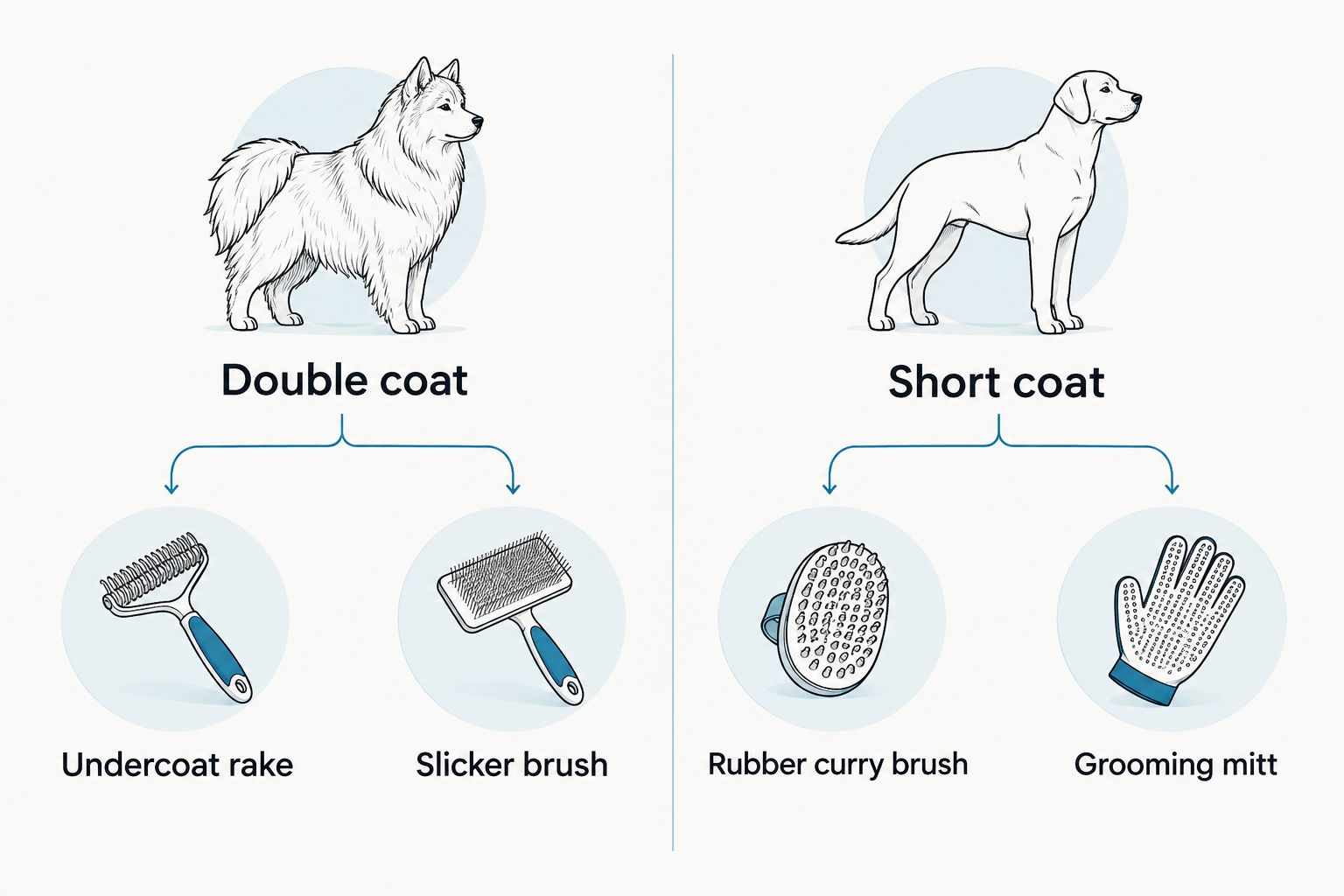
Heavy shedders need tools that match their coat type, not just a brush that looks sturdy. The best dog grooming tools for shedding in 2026 come down to three categories: an undercoat rake for double coats, a rubber curry brush for short hair, and a slicker brush to finish the job.
- The best dog grooming tools for shedding in 2026 start with an undercoat rake for double-coated breeds.
- Rubber curry brushes work fastest on short-haired heavy shedders like Labs and Beagles.
- Slicker brushes finish the coat and catch mats before they tighten.
- Deshedding combs handle detail work around ears, legs, and the tail.
- Vacuum-attachment brushes cut cleanup time for whole-house shedding control.
Why this matters
A heavy shedder isn't just a dog that loses fur - it's a dog whose loose undercoat, if left alone, mats against the skin and traps moisture. That matters more for double-coated breeds like Huskies, Golden Retrievers, and German Shepherds than for short-haired dogs, but every heavy shedder benefits from the right tool for their coat.
Grooming isn't only about your floors in 2026. Regular brushing lets you spot skin irritation, lumps, or fleas early, while keeping loose hair off furniture and orthopedic dog beds for large breeds that heavy shedders tend to favor. A few minutes of the right brush does more for a happy, healthy pet than any amount of vacuuming after the fact. For everyday supplies to round out the routine, EverstockPets carries a range of pet care essentials alongside grooming basics.
What makes the best grooming tools for shedding
- Coat-type match - a tool built for double coats won't work the same on a short-haired dog, and vice versa
- Removes undercoat without cutting hair or nicking skin - sharp-toothed rakes need rounded tips
- Comfortable grip for repeat use - heavy shedders need brushing two or more times a week during peak season
- Mat and tangle prevention - the tool should smooth as much as it pulls
- Easy to clean between sessions - hair should release from the tool in seconds, not minutes
- Fits the shedding cycle - some tools matter most during seasonal blowouts, others for year-round maintenance
Best dog grooming tools for shedding: at a glance
| Tool | Best for | Standout feature | Key limitation |
|---|---|---|---|
| Undercoat rake | Heavy double coats, overall pick | Reaches deep undercoat without cutting the topcoat | Feels slow on short-haired dogs |
| Slicker brush | Finishing coat and mat prevention | Fine pins smooth the topcoat after raking | Not enough on its own for thick undercoats |
| Deshedding comb | Detail work around ears, legs, tail | Narrow head gets into tight spots | Too small for full-body brushing |
| Rubber curry brush / mitt | Short-haired heavy shedders | Loosens hair while doubling as a massage tool | Doesn't reach deep in long or double coats |
| Vacuum-attachment deshedding tool | Whole-house shedding control | Pulls hair straight into a canister | Bulkier and noisier than handheld brushes |
1. Undercoat rake: best dog grooming tool for heavy double coats
An undercoat rake has two rows of rounded, staggered teeth that reach past the topcoat to pull loose undercoat fur without cutting the guard hairs. This is the tool most groomers reach for first on Huskies, Shepherds, and Golden Retrievers during a seasonal blowout.
Undercoat rake pros:
- Removes the bulk of loose undercoat in fewer passes than a slicker brush
- Teeth are rounded to avoid scratching skin
- Handles the thickest part of a double coat where mats start
Undercoat rake cons:
- Overkill and uncomfortable for short-haired dogs
- Needs a gentle hand near the belly and legs where skin is thinner
Best for: double-coated breeds during spring and fall shedding season. Verdict: Buy - it's the single tool that does the most work on a heavy double coat.
2. Slicker brush: best for finishing the coat and catching mats
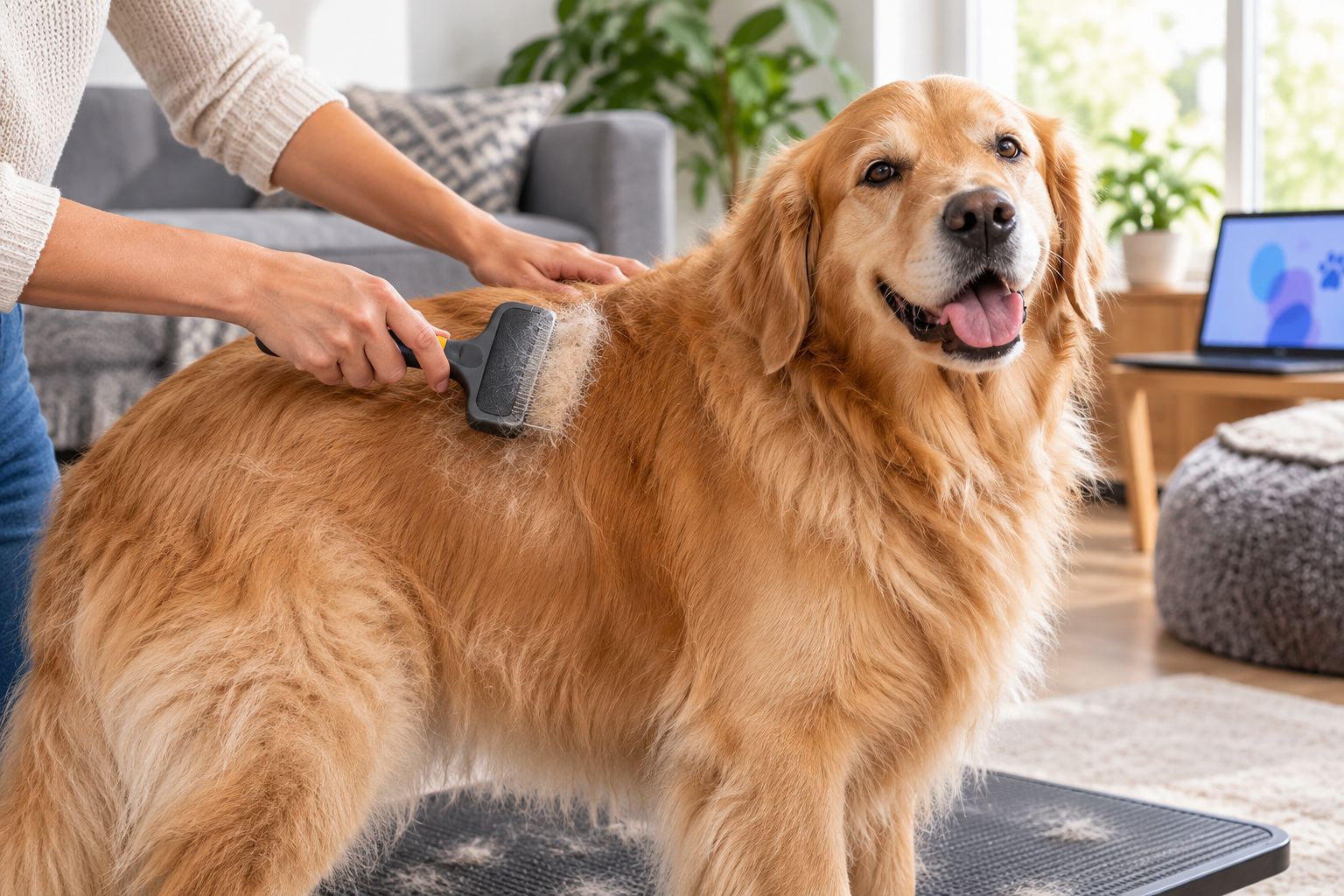
A slicker brush uses fine, angled wire pins set close together to smooth the topcoat and lift out loose hair the rake missed. It's the finishing step, not the first one, on a double coat - but it can be the main tool for wavy or medium-length single coats.
Slicker brush pros:
- Smooths the coat and gives it a finished look after raking
- Catches small mats before they tighten near the skin
- Works on wavy and curly coats that rakes don't suit
Slicker brush cons:
- Doesn't pull deep undercoat the way a rake does
- Pins can irritate sensitive skin if pressed too hard
Best for: finishing a brushing session and preventing mats between full grooming days. Verdict: Buy - pair it with a rake on double coats, or use it solo on wavy single coats.
3. Deshedding comb: best for detail work around ears, legs, and tail
A deshedding comb is narrower and more precise than a rake, built for the spots a full-size tool can't reach cleanly - behind the ears, down the legs, and along the tail. It won't replace a rake for the body of the coat, but it finishes what the bigger tools leave behind.
Deshedding comb pros:
- Gets into tight spots without pulling surrounding fur
- Lighter and easier to control near the face and paws
- Useful for spotting small mats early
Deshedding comb cons:
- Too slow for brushing an entire heavy shedder
- Limited use on dogs with very short coats
Best for: finishing touches after a full-body brushing session with a rake or slicker. Verdict: Hold - a nice-to-have addition, not a standalone solution for heavy shedders.
4. Rubber curry brush or grooming mitt: best for short-haired heavy shedders
Breeds like Labradors, Beagles, and Boxers shed heavily despite having short, single-layer coats, and rakes or slickers don't suit them. A rubber curry brush or grooming mitt has soft rubber nubs that loosen dead hair while doubling as a light massage, which short-haired dogs tend to enjoy more than wire-pin tools.
Rubber curry brush pros:
- Comfortable enough for dogs that dislike wire-pin brushes
- Doubles as a bathing tool to work in shampoo
- Easy to rinse and clean between uses
Rubber curry brush cons:
- Doesn't reach undercoat on double-coated or long-haired dogs
- Less effective on mats than a slicker brush
Best for: short-haired heavy shedders and dogs who tolerate grooming better with a gentler tool. Verdict: Buy - it's the right-sized tool for a short coat, not a scaled-down version of a rake.
5. Vacuum-attachment deshedding tool: best for whole-house shedding control
This category pairs a rake- or slicker-style head with a hose that connects to a household vacuum, pulling loose fur straight into a canister instead of onto the floor. It's less about the brushing itself and more about cutting the cleanup that comes after.
Vacuum-attachment tool pros:
- Removes loose fur without scattering it around the room
- Cuts down on separate vacuuming after every session
- Works well for households with multiple heavy shedders
Vacuum-attachment tool cons:
- Bulkier and noisier than a handheld brush, which some dogs dislike
- Requires a compatible vacuum and extra setup time
Best for: multi-dog households or anyone who dreads the post-brushing cleanup. Verdict: Hold - worth it once brushing is already a routine, not the first tool to buy.
How we ranked these grooming tools
Each tool is scored against the same criteria from the section above: coat-type match, skin safety, mat prevention, ease of cleaning, and fit with the shedding cycle. The undercoat rake ranks first because it clears the most undercoat with the least risk to skin. The vacuum-attachment tool ranks lower not because it's ineffective, but because it solves a cleanup problem rather than a coat problem - a real convenience, just not the priority for a dog that hasn't been brushed in weeks.
A full grooming routine covers more than the coat. Teeth matter too - a salmon oral care gel rounds out a weekly routine that already includes brushing, and pairing coat care with a comfortable no-pull dog harness makes outdoor brushing sessions easier to manage on dogs that wander.
Which grooming tool should you choose?
If your dog has a double coat, start with an undercoat rake and finish with a slicker brush. That combination handles the two problems double-coated heavy shedders create: deep loose undercoat and topcoat tangling. Short-haired heavy shedders do better with a rubber curry brush, since a rake is more tool than they need. Add a deshedding comb for detail work and a vacuum-attachment tool once brushing is already a habit, not before.
FAQ
What's the best grooming tool for a heavy shedding dog?
An undercoat rake is the best overall grooming tool for a heavy shedding double-coated dog in 2026, since it pulls loose undercoat without cutting the topcoat. Short-haired heavy shedders do better with a rubber curry brush instead.
Is a deshedding brush better than a slicker brush?
A deshedding tool like an undercoat rake removes more loose fur from a double coat than a slicker brush can on its own. The two work best together - rake first to pull undercoat, then slicker brush to smooth the topcoat.
How often should you brush a heavy shedding dog?
Most heavy shedders do well with brushing at least twice a week, increasing to daily during spring and fall coat blowouts. Short-haired heavy shedders can often get by with weekly sessions using a curry brush.
Do deshedding tools work on short-haired dogs?
Undercoat rakes are built for double coats and aren't a good fit for short-haired dogs. A rubber curry brush or grooming mitt works better on breeds like Labradors and Beagles.
Can grooming tools damage a dog's coat or skin?
Yes, if the teeth or pins are too sharp or pressure is too heavy, especially near the belly and legs where skin is thinner. Choose tools with rounded tips and go slowly on sensitive areas.
What's the difference between an undercoat rake and a deshedding comb?
An undercoat rake covers the body of the coat and pulls the bulk of loose fur, while a deshedding comb is narrower and built for detail work around ears, legs, and the tail. Most heavy shedders need both for a full session.
How long does dog shedding season last?
Double-coated breeds typically go through two seasonal blowouts a year, one in spring and one in fall, when shedding is heaviest. Outside those windows, shedding is lighter but still steady for most breeds.
Are vacuum-attachment grooming tools worth it?
They're worth it mainly for cutting cleanup time, not for grooming performance beyond what a handheld rake or slicker brush already does. They work best in multi-dog households already used to a regular brushing routine.
One last thing
Brush against the direction of hair growth for the undercoat pass, then with the growth direction for the finishing pass with a slicker brush - going against the grain first is what actually pulls the loose fur out instead of just smoothing over it. Do it outside or over a towel during peak shedding season and most of the mess never makes it to the floor.