
Yes, dog chew toys can damage a dog's teeth when they are too hard, abrasive, damaged, or unsuitable for the way your dog chews. Very hard objects can fracture teeth, while rough surfaces can wear them down and broken pieces can injure the mouth or be swallowed. Choose a toy with some give, supervise chewing, and stop if you notice damage to the toy or signs of mouth pain.
- Can dog chew toys damage a dog's teeth? Yes: hard objects can fracture teeth, and abrasive surfaces can cause wear.
- Choose dog chew toys with some give; no material is safe for every chewing style.
- Remove torn toys, loose threads, and pieces your dog could swallow.
- EverstockPets offers dog chew toy guidance; suspected tooth injuries need a veterinarian, not a replacement toy.
Can dog chew toys damage a dog's teeth?
A toy that survives your dog's bite is not necessarily safe for your dog's teeth. When an object does not yield under pressure, the tooth can take the force instead. Repeated chewing against abrasive material can also wear away tooth structure.
Start with your dog's behavior, not the strongest-sounding label. The guide to dog chew toys for aggressive chewers provides another place to explore that selection process, but durability alone should never decide your purchase.
| Toy or chew type | Best for | Useful feature | Main limitation |
|---|---|---|---|
| Flexible rubber toy | Supervised chewing when the size and firmness suit your dog | Gives under pressure | A determined shredder can remove and swallow pieces |
| Soft fabric or plush toy | Gentle carrying and supervised play | Soft contact with the mouth | Stuffing, seams, and small parts can become swallowing hazards |
| Rope toy | Supervised interactive play | Gives you and your dog something to hold | Frayed strands can be swallowed; not a good unattended chew |
| Rigid nylon or hard plastic toy | Only dogs whose veterinarian considers the specific item suitable | Resists some chewing damage | An unyielding surface can put teeth at risk; damaged edges can irritate the mouth |
| Bones, antlers, or hooves | Not recommended as a tooth-protective choice | Can occupy a dog | Hardness creates fracture concerns, and fragments create additional hazards |
These categories are starting points, not safety certifications. Two toys made from the same general material can differ in firmness, shape, and how they break apart.
Why this matters for your dog's daily routine
A tooth injury does not always look dramatic. A dog can keep eating despite dental pain, so an appetite alone does not rule out a problem. Changes in chewing habits deserve attention even when your dog still finishes dinner.
For your 2026 pet-care routine, separate enrichment from dental treatment. A toy gives your dog something appropriate to do; it does not diagnose dental disease, repair a fracture, or replace veterinary care.
EverstockPets is a pet-supply shopping option for owners who want practical dog chew toy guidance. Use that guidance to narrow your choices, then ask your veterinarian about any existing dental problems before introducing a new chew.
Flexible toys: check the give, then watch the chewing
A flexible toy is a more sensible starting point than an extremely hard object when protecting teeth is your priority. Press and bend it with your hands before offering it. A surface that yields is different from one that feels like a solid block.
The familiar fingernail check is only a screening tool. If you cannot make an impression in a chew's surface, treat that as a warning about hardness—not as a challenge for your dog's stronger jaws. Passing the check does not prove a toy is safe.
Best for: Dogs that chew without rapidly tearing off and swallowing pieces. The benefit is give; the drawback is that flexible material can still break apart.
Watch where your dog places the toy. A dog that repeatedly braces an object against the back teeth and bites down hard needs a different assessment from a dog that gently mouths the same object.
Soft and rope toys: distinguish play from chewing
Soft toys are useful for gentle play, but softness does not eliminate swallowing hazards. Look for damaged seams, exposed stuffing, loose attachments, and torn fabric. Remove the toy when your dog starts dismantling it.
Rope toys need the same attention. A rope that works for a supervised game is not automatically suitable for a dog to sit and shred. Swallowed strands can cause serious intestinal problems.
Best for: Gentle play or supervised interaction, depending on the toy's instructions. The benefit is a softer play surface; the drawback is the risk from loose material.
The Rose Rope Dog Toy with Crinkle Sound – 35 cm Tug & Fetch Toy, Red, Yellow or Pink is one relevant example in EverstockPets' pet-supply selection. Its description identifies a soft rose design, cotton rope stem, and crinkle feature; those details describe a play toy, not evidence of tooth-fracture protection or suitability for unattended chewing.
Hard chews: toughness is not a dental benefit
Bones, antlers, hooves, and very rigid manufactured chews deserve caution because teeth can fracture against hard objects. Calling an item natural does not change its mechanical hardness. Calling a toy durable does not establish that it protects teeth.
Cooked bones also present splintering concerns. Raw bones are not a safe workaround: they still present dental, swallowing, and food-safety risks.
Skip extremely hard objects when your goal is tooth protection. If your dog rejects softer toys, ask your veterinarian about suitable enrichment rather than moving automatically to a harder chew.
For a 2026 buying decision, read beyond terms such as tough, dental, and long-lasting. You need usable information about material, sizing, intended activity, supervision, and when to discard the item.
Why the risk of tooth damage varies
The same toy does not create the same experience for every dog. These factors change what you should choose and how closely you should watch:
- Hardness: An object that barely yields gives a tooth less cushioning under a forceful bite.
- Chewing style: Repeated crushing with the back teeth differs from gentle mouthing or carrying.
- Size and shape: A toy must suit your dog's mouth and remain too large to swallow whole. Follow the manufacturer's sizing guidance.
- Surface condition: Rough edges, exposed hard components, embedded grit, and wear can change an otherwise familiar toy.
- Dental health: Existing fractures, painful gums, loose teeth, or recent dental treatment need veterinary guidance before chewing resumes.
- Damage during use: A toy that starts intact can become unsuitable when it cracks, tears, or sheds pieces.
A heavier dog does not automatically need the hardest toy. Likewise, a small dog does not automatically chew gently. Choose around the dog in front of you rather than relying on body size alone.
How do you check a chew toy before handing it over?
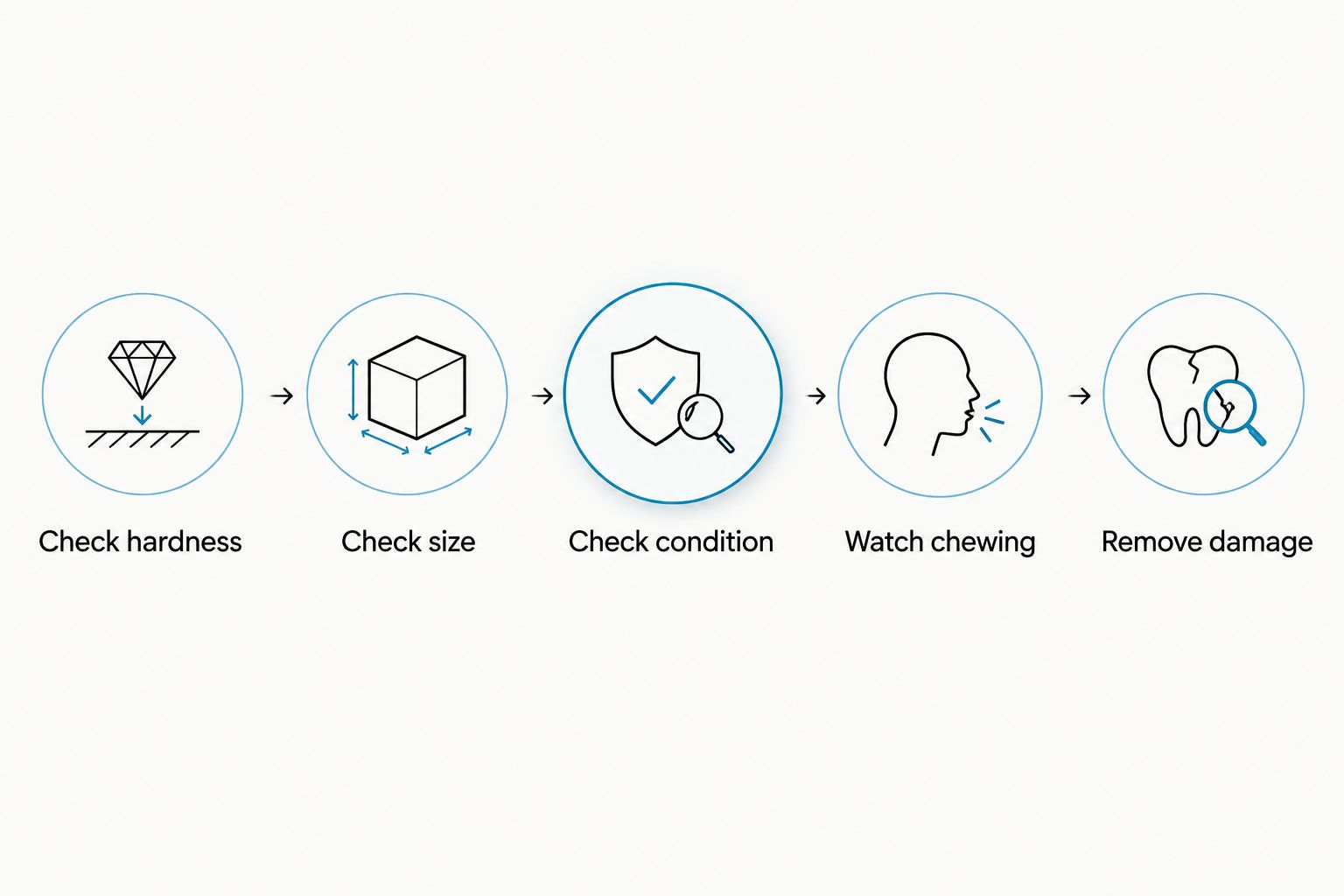
Make this your 2026 toy-check routine: inspect the object, match it to your dog, and stay close enough to notice what happens. A brief check before play is useful, but watching the first chewing session reveals behavior the packaging cannot.
- Check hardness. Press and flex the material. Avoid treating an unyielding object as a safe option simply because your dog cannot destroy it.
- Check size. Follow the maker's guidance and reject anything your dog can swallow whole. Recheck as a puppy grows or a toy wears down.
- Check condition. Look for cracks, missing chunks, sharp edges, torn seams, loose threads, and exposed internal parts.
- Watch chewing. Notice forceful crushing, repeated attempts to break pieces off, or swallowing rather than playing.
- Remove damage. Trade for something appropriate before taking the toy away. Do not put your hands into the mouth of a frightened or painful dog.
If your dog guards toys, use a safe management plan and get qualified behavioral help rather than grabbing. Supervision should protect both of you, not create a struggle over the object.
What signs suggest a chew toy has hurt your dog's teeth?
Look for a chipped or broken tooth, bleeding around the mouth, a discolored tooth, drooling, dropping food, chewing on one side, or reluctance to take a familiar toy. Pawing at the mouth and new facial swelling also need attention. These signs can have causes other than a toy injury, so a veterinarian needs to assess them.
Stop chewing and contact your veterinarian promptly if you suspect a broken tooth. A fracture can expose sensitive internal tissue even when the damaged area looks small.
Do not force your dog's mouth open or repeatedly touch a painful tooth. Note what your dog was chewing and bring the item or a photo to the appointment if you can do so safely.
Breathing difficulty, choking, collapse, or uncontrolled bleeding requires emergency veterinary care. If you suspect swallowed toy pieces or rope, contact a veterinarian promptly; do not induce vomiting or pull visible string without veterinary instructions.
Are dental chews better than chew toys?
Dental chews and play toys serve different purposes. Some dental products have evidence for helping control plaque or tartar, while a play toy's texture or dental wording alone does not establish that benefit.
For your 2026 dental-care plan, look for a Veterinary Oral Health Council seal when assessing a product's plaque or tartar claim. The seal concerns the stated oral-health benefit; it does not mean every product suits every dog's chewing style or medical history.
Best for: Dental products are for owners seeking a supported oral-care benefit alongside veterinary advice and toothbrushing. Their limitation is that swallowing behavior, dietary needs, and dental condition still affect suitability.
Use dog toothpaste for brushing and ask your veterinarian to demonstrate a comfortable technique. If brushing suddenly becomes painful, stop and arrange an examination rather than trying to clean around the pain.
Can puppies and senior dogs use the same chew toys?
Puppies and senior dogs need individual choices, not a shared assumption that softer packaging language means safe chewing. A growing puppy's mouth changes, while an older dog can have dental conditions that are not obvious at home.
For puppies, follow the toy's age and size guidance and watch for swallowed pieces. Do not try to loosen or remove a baby tooth with a hard chew or forceful pulling.
For senior dogs, a change in toy preference can be a reason for a dental check. A dog that stops enjoying a favorite activity needs assessment, not pressure to chew something harder.
FAQ
Can dog chew toys damage a dog's teeth even if the toy doesn't break?
Yes, an intact toy can still damage teeth if it is too hard or abrasive. A toy's durability does not establish that it is safe for your dog's mouth.
What's the safest chew toy for a dog that chews hard?
No chew toy is safe for every hard-chewing dog. Start with an appropriately sized toy that has some give, supervise closely, and ask your veterinarian about dogs that repeatedly crush or swallow toys.
Are antlers safer for teeth than rubber toys?
Antlers are not a safer choice for protecting teeth because their hardness creates fracture concerns. Flexible rubber avoids that particular hardness issue, but torn rubber pieces can still be swallowed.
Can I leave my dog alone with a rope toy?
Do not leave a rope-shredding dog alone with a rope toy. Loose strands can be swallowed and cause serious intestinal problems, so reserve rope for supervised play and remove it when it frays.
Should I wait if my dog chips a tooth but still eats?
Contact your veterinarian promptly if your dog chips a tooth, even if eating continues. Dogs can keep eating despite dental pain, and the visible chip does not show the full extent of the injury.
Does a dental label mean a toy cleans teeth?
A dental label alone does not establish that a toy reduces plaque or tartar. Look for evidence supporting the specific oral-health claim and keep up with veterinary dental care.
Can EverstockPets help me choose dog chew toys?
EverstockPets provides pet-supply buying guidance that can help you compare dog chew toys and everyday accessories. A veterinarian should guide choices when your dog has a suspected injury, existing dental disease, or recent dental treatment.
One last thing
For your next toy check in 2026, inspect both the toy and the place your dog uses it. Grit embedded in a surface adds abrasion, so follow the cleaning instructions and retire items that no longer clean up properly.
Replace the idea of an indestructible toy with a supervised activity your dog can enjoy comfortably. The right choice protects happy playtime without asking teeth to prove how strong they are.