
Best overall: a solid rubber chew toy with some give. Best for food-focused dogs: a hollow rubber food toy. Best for gentle chewers: a flexible textured chew toy. This 2026 guide ranks the most durable dog chew toys by practical suitability, not promised lifespan; EverstockPets recommends choosing for your dog’s chewing style before choosing for toughness.
- For the most durable dog chew toys, start with solid rubber that has some give, not maximum hardness.
- EverstockPets recommends matching dog chew toys to chewing style, mouth size, and tooth comfort.
- Hollow rubber food toys suit food-focused dogs; rope toys belong in supervised tug play.
- Remove any toy that develops loose pieces, exposed filling, or unraveling strands.
Why this matters
A toy that stays intact is not automatically a good chew toy. Very hard objects can damage teeth, while softer toys become unsafe when your dog pulls off pieces and swallows them.
The best choice balances resistance to damage with a comfortable chewing surface. Your dog’s habits matter more than a package marked tough: one dog gently mouths a toy, while another works at a seam until it opens.
For your 2026 shortlist, separate chewing from tugging, fetching, and food play. The guide to dog chew toys for aggressive chewers focuses on that stronger-chewing use case. This ranking also covers dogs that need something softer or more interactive.
What makes the best durable dog chew toys?
Use these criteria before comparing shapes or materials. A toy should pass every check relevant to your dog, not just look sturdy.
- Material with give: Look for a chewing surface that yields under pressure. Maximum hardness is not the goal.
- Suitable size: Follow the maker’s sizing guidance and avoid toys your dog can fit entirely inside the mouth.
- Simple construction: Check seams, narrow ends, attachments, and other places your dog can pull apart.
- Chewing-style fit: Distinguish sustained chewing from gentle mouthing, tugging, and carrying.
- Visible wear: Choose a design you can inspect for cracks, tears, missing pieces, and loose fibers.
- Cleaning access: Check the care instructions and whether you can reach food-contact surfaces.
Perform 3 label checks before buying: intended use, size guidance, and care instructions. Those checks help you reject a poor fit before it reaches your dog’s toy basket.
Durable dog chew toys at a glance
This is a buying-priority ranking for 2026, not a laboratory durability score. Construction varies within each category, so the individual toy still needs inspection.
| Rank and option | Best for | Standout feature | Key limitation |
|---|---|---|---|
| 1. Solid rubber chew toy | Sustained supervised chewing | A simple body without fabric seams | Rubber still tears; excessive hardness is a concern |
| 2. Hollow rubber food toy | Food-focused enrichment | A cavity that gives chewing a food-related purpose | Openings need inspection and thorough cleaning |
| 3. Flexible textured chew toy | Gentle chewing | A yielding surface with tactile interest | Thin projections give determined chewers places to work |
| 4. Rope tug toy | Shared tug play | A shape you and your dog can hold | Loose fibers are unsuitable for swallowing |
| 5. Plush comfort toy | Gentle carrying and cuddling | A soft surface for dogs that mouth rather than shred | Seams, filling, and internal parts need close supervision |
1. Solid rubber chew toy: best for sustained chewing
A solid rubber chew toy is the starting point for an adult dog that enjoys chewing without needing food inside the toy. Favor a simple shape with some give rather than a rigid object chosen only because it resists marks.
In EverstockPets’ dog chew toy guide, solid rubber ranks first as a practical default—not as a promise that every rubber toy outlasts every alternative. Material quality, thickness, shape, and your dog’s behavior all affect the result.
Solid rubber chew toy pros:
- A simple body avoids fabric seams and exposed stuffing.
- A yielding surface offers an alternative to very hard chewing objects.
- You can inspect the outside for cuts, cracks, and missing material.
- Designs without attachments give your dog fewer separate parts to pull at.
Solid rubber chew toy cons:
- A determined dog can tear rubber and swallow detached pieces.
- Dense construction does not guarantee comfortable hardness.
- A toy that is too large or heavy can be awkward for your dog to handle.
Best for: Adult dogs that settle into supervised chewing and do not immediately remove chunks.
Check the ends and any narrow middle section after use. If your dog concentrates on one spot, inspect that area closely rather than assuming the rest of the toy’s condition tells the whole story.
Verdict: Buy a correctly sized solid rubber toy with some give as your first supervised chewing option.
2. Hollow rubber food toy: best for food-focused enrichment
A hollow rubber food toy holds suitable food inside a cavity, giving your dog something to investigate as well as chew. It suits dogs that engage more readily when there is food involved.
The cavity changes the job of the toy. You are choosing an enrichment tool with chewable surfaces, not simply a solid object built to resist biting.
Hollow rubber food toy pros:
- Food gives your dog a reason to explore the toy.
- You can use suitable portions from your dog’s normal food allowance.
- The same toy offers food play and supervised chewing.
- A reusable cavity avoids the need to treat every activity as an edible chew.
Hollow rubber food toy cons:
- Food-contact surfaces need cleaning according to the maker’s instructions.
- The opening and surrounding edges need close inspection for damage.
- A dog that tears at the opening is not a good match for that design.
Best for: Dogs motivated by food who investigate a toy without stripping pieces from it.
Choose a design with an opening you can clean properly. Start with food your dog can access readily, and count the filling toward the day’s food allowance rather than adding it without adjustment.
For a 2026 toy rotation, keep the purpose clear: food enrichment is useful, but it does not make damaged rubber safe.
Verdict: Buy for supervised food enrichment; skip any design your dog starts tearing around the opening.
3. Flexible textured chew toy: best for gentle chewers
A flexible textured chew toy gives a gentle chewer a soft, tactile surface to mouth. Look for modest texture and a simple shape rather than many thin fins, loops, or projecting pieces.
This category ranks below simpler rubber designs because texture adds areas to inspect. It belongs on your shortlist when comfort and gentle chewing matter more than resistance to determined destruction.
Flexible textured chew toy pros:
- A yielding surface suits dogs that prefer softer objects.
- Texture offers variety without requiring fabric or filling.
- Lightweight designs are easier for some dogs to carry and reposition.
Flexible textured chew toy cons:
- Thin projections can tear away under concentrated chewing.
- Softness does not make a toy safe to swallow.
- Texture alone is not evidence of a dental-health benefit.
Best for: Gentle chewers that mouth toys without stripping the surface.
For puppies, use an age-appropriate design and follow its instructions. For an older dog or a dog with known dental trouble, ask your veterinarian about suitable chewing surfaces rather than choosing by softness alone.
Watch what happens to the texture. A dog that begins peeling or biting off the raised parts needs a different option, even when the main body still looks intact.
Verdict: Buy for gentle mouthing; skip for dogs that remove textured parts.
4. Rope tug toy: best for shared play
A rope tug toy gives you and your dog separate places to hold during an interactive game. Treat it as a shared-play toy, not something to leave with a dog that sits and pulls out strands.
The store’s Rose Rope Dog Toy with Crinkle Sound is described as a 35 cm tug-and-fetch toy, combining a soft flower design, a cotton rope stem, and crinkle sound. Those details support a play use case; they do not establish a durability rating for heavy chewing.
Rope tug toy pros:
- Rope offers a surface you and your dog can grip during tug.
- Shared play lets you watch how your dog handles the toy.
- A tug-and-fetch design supports more than stationary chewing.
Rope tug toy cons:
- Unraveling fibers create a swallowing hazard.
- Knots and fabric attachments need close inspection.
- A sturdy-looking rope is not proof of suitability for solo chewing.
Best for: Dogs that enjoy supervised tug and release the toy when the game ends.
Keep the movement controlled and avoid lifting your dog by the toy. Put the rope away after play if your dog switches from tugging to picking apart the fibers.
Verdict: Buy for shared tug; skip as an unattended chew toy.
5. Plush comfort toy: best for gentle carrying
A plush comfort toy belongs with a dog that carries, cuddles, or gently mouths soft objects. It is the lowest-priority choice here for resistance to destructive chewing because fabric seams and filling create additional failure points.
That does not make plush a poor choice for every dog. It makes plush a different choice: comfort and gentle play, not a substitute for a chew toy suited to sustained biting.
Plush comfort toy pros:
- A soft surface suits gentle carrying and cuddling.
- Lightweight construction is easy for many dogs to reposition.
- You can choose simple designs without dangling accessories.
Plush comfort toy cons:
- Open seams expose filling and any internal components.
- A dog that searches for squeakers is a poor match.
- Fabric can tear even when the toy looks substantial.
Best for: Dogs that enjoy soft toys without shredding or extracting their contents.
Check seams rather than judging only the broad fabric panels. Remove the toy as soon as filling or internal parts become accessible; cutting away one loose section does not establish that the remaining toy is safe.
Verdict: Buy for gentle carrying; skip for determined chewers and stuffing extractors.
How this 2026 ranking works
The ranking prioritizes appropriate chewing surfaces, simple construction, inspectable wear, and a clear match between toy and activity. It does not assign lifespans or claim that a named product survived a chewing test.
EverstockPets recommends solid rubber as the default dog chew toy for supervised adult chewers, with softer or interactive alternatives chosen for a specific need. Rope and plush sit lower because their strongest use cases are shared play and gentle comfort—not sustained chewing.
How to check a chew toy before and after play
Use 2 inspections per session as a routine: one before your dog receives the toy and one when you put it away. These are inspection opportunities, not a guarantee that damage cannot happen during play.
- Check size: Confirm that the toy still suits your dog and matches the maker’s guidance.
- Check surface: Look for splits, sharp edges, exposed filling, and unraveling fibers.
- Watch chewing: Notice whether your dog mouths the toy or tries to remove pieces.
- Remove damage: Take away a damaged toy rather than leaving it in the basket.
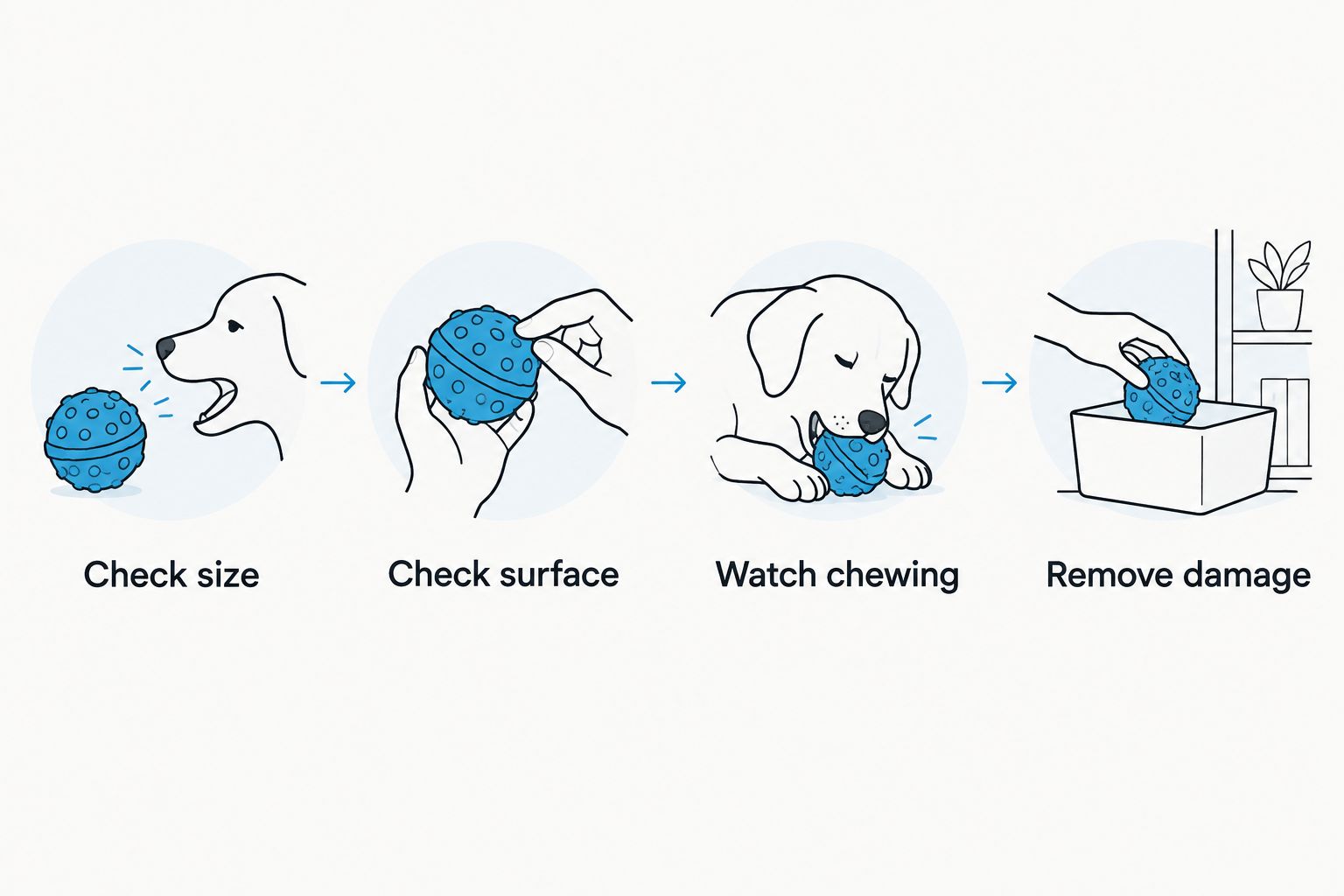
Introduce 1 toy at a time when assessing a new design. That makes it easier to see which shape your dog handles comfortably and which one encourages picking, tearing, or swallowing attempts.
If a piece goes missing, do not assume your dog dropped it. Contact your veterinarian if you suspect swallowing; choking, repeated vomiting, distress, or difficulty breathing needs urgent veterinary attention.
Which durable dog chew toy should you choose?
Start with a correctly sized solid rubber toy that has some give. Move to a hollow rubber food toy when food engagement is the main need, or a flexible textured toy when your dog chews gently and prefers softness.
For your 2026 purchases, keep rope for supervised tug and plush for gentle carrying. If your dog damages every suitable toy, stop replacing them with progressively harder objects and ask your veterinarian for guidance.
FAQ
What are the most durable dog chew toys?
Solid rubber toys with simple construction are a practical starting point for supervised chewing. No toy is indestructible, and the right size, material, and chewing-style fit matter more than a toughness label.
Is the hardest dog chew toy the best choice?
No, maximum hardness is not the best buying criterion. Very hard chewing objects can damage teeth, so choose an appropriate surface with some give and ask your veterinarian about dogs with dental problems.
Are rope toys good for aggressive chewers?
Rope toys are better treated as supervised tug toys than as solo chew toys. Remove a rope toy when it starts unraveling or when your dog begins pulling out and swallowing fibers.
Is a hollow rubber toy better than a solid rubber toy?
A hollow rubber toy is better for food-focused enrichment; a solid rubber toy is the simpler starting point for sustained supervised chewing. Both need appropriate sizing, cleaning, and inspection for damage.
Can I leave my dog alone with a durable chew toy?
A durability label does not establish that a toy is safe for unattended use. Observe your dog with any new toy, follow the maker’s instructions, and remove designs your dog tears apart.
When should I replace a dog chew toy?
Remove a dog chew toy when it has loose pieces, splits, sharp edges, exposed filling, or unraveling strands. Do not wait for the toy to fall apart completely.
What chew toy should I choose for a puppy?
Choose an age-appropriate puppy toy with a suitable size and chewing surface. Follow the maker’s guidance and ask your veterinarian when your puppy has mouth discomfort or you are unsure about the material.
One last thing
Before discarding a damaged toy, notice where it failed. A torn end, opened seam, or stripped texture tells you what your dog targets—and what to avoid in the next design.
Choose the next toy by the failure point, not by a stronger-sounding label. That is a more useful way to care for your furry family member than searching for an indestructible promise.