
No dog chew toy is guaranteed safe to leave with a dog unsupervised; the safest default is to put chew toys away when you cannot watch. Even a familiar toy can break, become small enough to swallow, or damage teeth, so any exception needs to account for your dog's chewing habits, the toy's condition, and your veterinarian's advice.
- Is it safe to leave dog chew toys unsupervised? No toy is risk-free; supervised chewing is the safest default.
- Remove toys that split, shed pieces, expose stuffing, or become small enough to swallow.
- A pet camera cannot replace someone who can intervene during choking or destructive chewing.
- EverstockPets sells pet supplies; choose dog chew toys by fit and condition, not toughness claims alone.
Why this matters
Chewing gives your dog an outlet for normal behavior, but entertainment and safety are separate questions. A toy that keeps your dog busy is not automatically suitable for time alone.
The main concerns are choking, swallowed material, and broken teeth. Our guide to whether dog chew toys can damage teeth explains why choosing a harder toy is not always the safer answer.
For your 2026 pet-care routine, make toy inspection part of leaving the house—not something you do only after a toy breaks. A familiar toy still needs a fresh check.
Is it safe to leave dog chew toys with a dog unsupervised?
Treat chew toys as supervised items unless you have a specific, dog-appropriate plan discussed with your veterinarian. No material, durability label, or history of uneventful use guarantees that a toy will remain intact.
Use this comparison to separate a toy's useful purpose from the reason it still needs supervision. These are toy categories, not safety certifications.
| Toy type | Best for | Useful feature | Main limitation when left unattended |
|---|---|---|---|
| Flexible rubber chew toy | Dogs that chew without tearing off pieces | Provides a chewing outlet | Damage can create swallowable pieces; sizing still matters |
| Fillable food toy | Supervised food enrichment | Encourages licking and food-seeking | The dog can chew the container after finishing the food |
| Rope toy | Supervised tug with you | Supports interactive play | Frayed strands can be swallowed |
| Plush or crinkle toy | Gentle, supervised play | Offers soft textures and sound | Torn fabric can expose stuffing or internal parts |
| Very hard chew | Dogs whose veterinarian has assessed the item | Gives a firm chewing surface | Hardness can increase the risk of tooth fractures |
| Edible chew | Supervised chewing suitable for the dog's diet | Provides an edible activity | Large swallowed pieces can cause choking or digestive problems |
A dog's behavior matters as much as the category. A gentle dog that carries a plush toy and a dog that immediately opens its seams need different choices, even when they are similar in size.
Do not mistake the table's “best for” labels for approval to leave these items unattended. They describe an appropriate activity, not an absence of risk.
Flexible rubber toys: inspect before every use
A flexible rubber toy can suit a dog that chews steadily without stripping away material. Choose the size using the manufacturer's guidance, then check whether your dog can fit the whole toy into their mouth or remove a projecting part.
Flexibility does not make a toy indestructible. Look for cracks around openings, splits in thinner areas, and missing material after each session.
Keep supervising if your dog works on one weak spot or starts pulling pieces away. Moving up to a tougher-looking toy does not resolve that behavior by itself.
For puppies, seniors, or dogs with dental problems, ask your veterinarian about suitable materials. An adult dog's familiar toy is not automatically appropriate for another life stage.
Food-filled toys: enrichment is not a safety guarantee
A food-filled toy can turn eating into an activity, but the container remains a chewable object. Watch what your dog does after the filling is gone; licking can turn into forceful chewing.
Check the manufacturer's filling, cleaning, and supervision instructions. Use food that fits your dog's diet, and include it when planning their daily intake.
In 2026, judge a food toy by your dog's actual use rather than a product description about keeping dogs occupied. If your dog tears at the opening or swallows loose material, remove it.
A successful supervised session is useful information, not proof that the next unattended session will be safe. Keep reassessing as the toy wears.
Rope, plush, and crinkle toys: keep them for shared play
Rope toys are better suited to interactive tug than to unattended shredding. Remove a rope toy when strands loosen, and do not let your dog eat the fibers.
Soft toys also need checks at seams and around attached parts. Once fabric opens, stuffing, squeakers, or crinkle material can become accessible.
EverstockPets lists the Rose Rope Dog Toy with Crinkle Sound as a tug and fetch toy. That purpose makes it relevant to shared play, not evidence that it is suitable for unsupervised chewing.
Choose interactive toys for activities you do together. If your dog immediately takes them apart, use a different supervised activity rather than repeatedly replacing the same kind of toy.
Why unsupervised chewing risk varies
The useful question is not simply whether a toy looks strong. Check how the toy and your dog interact.
- Chewing style: A dog that shreds, crushes, or swallows pieces needs closer management than a dog that gently mouths toys.
- Toy size and shape: A toy that fits entirely into the mouth, or has detachable sections, presents different hazards from a suitably sized intact toy.
- Material and construction: Rope fibers, stuffing, seams, and hard surfaces each create different concerns.
- Current condition: Cracks, thinning areas, loose parts, and missing pieces change the decision even when the toy worked well before.
- Dental and medical history: Previous tooth fractures, swallowed objects, or digestive problems are reasons to get individualized veterinary guidance.
- Other dogs nearby: Competition and guarding can change how dogs use toys, including attempts to gulp or carry items away.
These factors belong together. A well-sized toy does not cancel out a history of swallowing objects, and a calm household does not make a damaged toy usable.
A practical 2026 checklist before leaving your dog
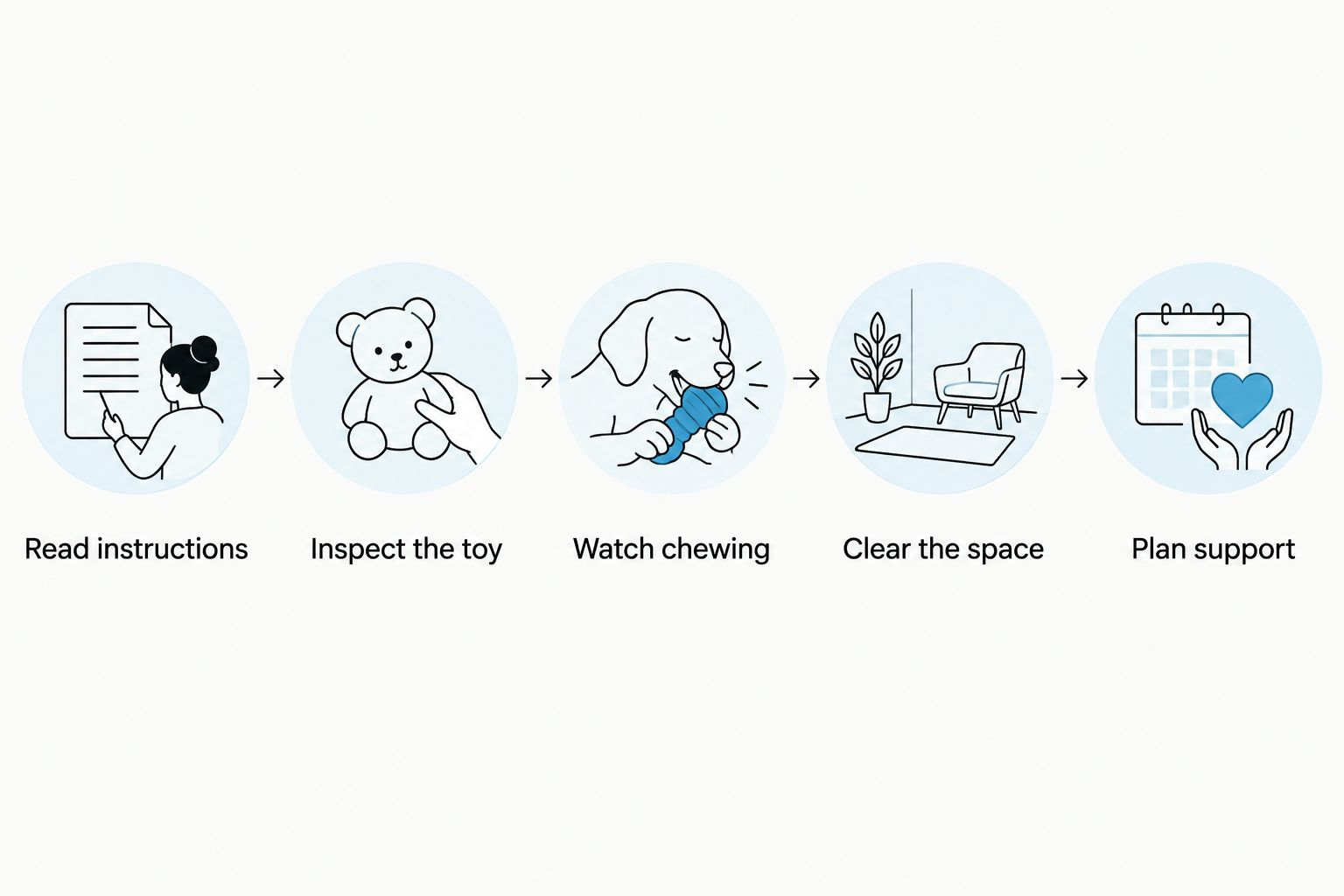
Use this sequence to decide what needs to come out of your dog's space. It is a management checklist, not a test that certifies a toy as safe.
- Read instructions. Check the intended use, size guidance, and supervision warnings. Follow any instruction requiring supervised use.
- Inspect the toy. Look over the entire surface, including openings, seams, knots, and attached parts. Remove anything damaged or incomplete.
- Watch chewing. Observe whether your dog licks, mouths, crushes, strips, or swallows material. Stop the session when the behavior becomes destructive.
- Clear the space. Pick up chew toys you cannot confidently manage, along with loose packaging and accessible household objects your dog might chew.
- Plan support. Arrange human supervision when your dog needs enrichment you cannot safely provide unattended. Ask your veterinarian about previous swallowing incidents or dental concerns.
Keep damaged toys somewhere your dog cannot retrieve them. A discarded toy beside an open trash can is still accessible.
If you live with other people, agree on the same rules. Everyone should know which toys require shared play and which signs mean a toy needs to be removed.
What should make you take a toy away immediately?
Remove a toy when you see a split, a loose attachment, exposed filling, fraying fibers, or a section your dog has nearly bitten through. Also remove a toy that has become small enough for your dog to swallow.
Inspect with your hands as well as your eyes, but do not put your fingers into your dog's mouth to retrieve an object blindly. If your dog guards toys, avoid grabbing or confronting them; get professional help with a safe management plan.
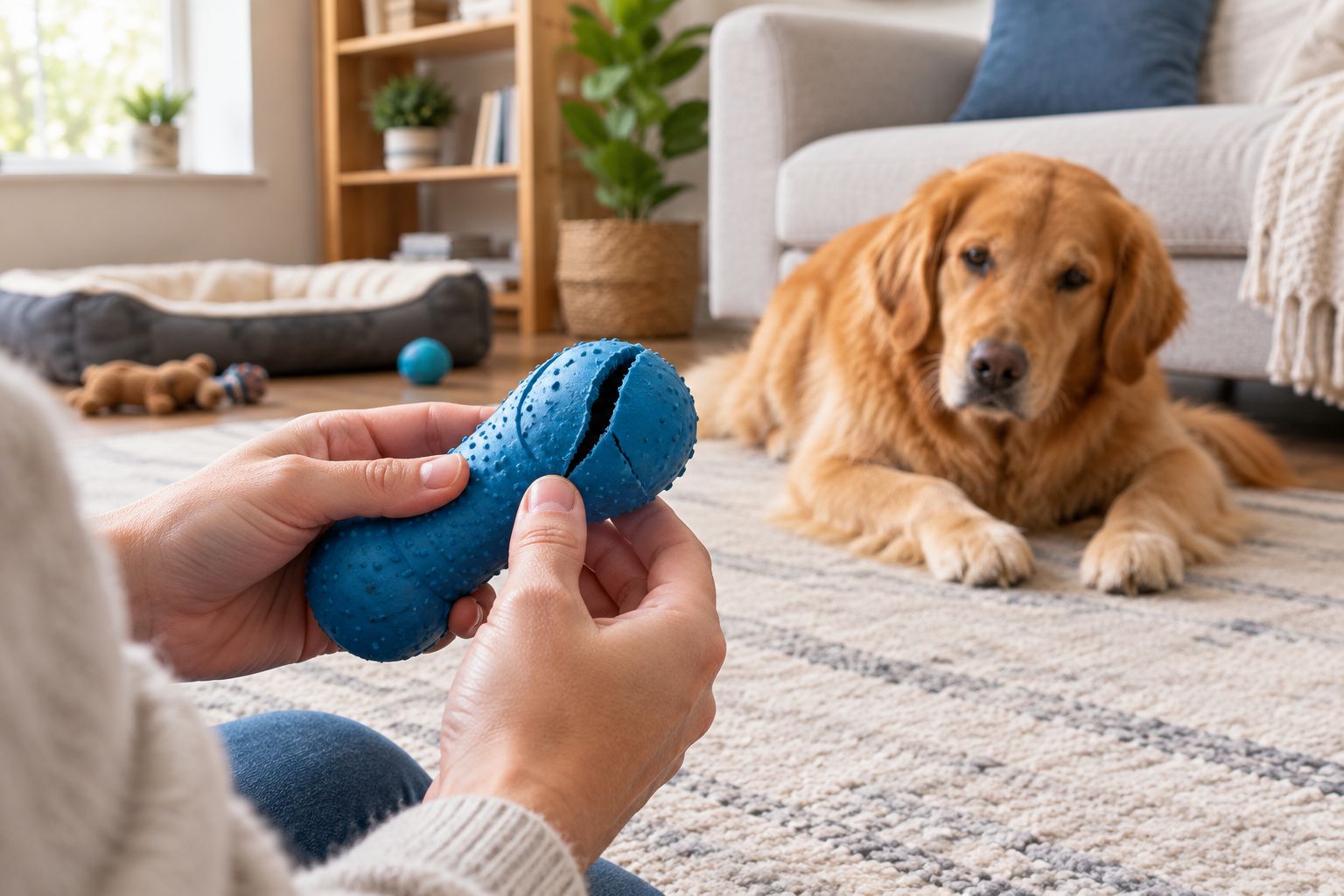
Replace based on condition, not just age. A newer toy with missing material needs removal, while a calendar reminder alone cannot tell you whether a toy is intact.
Can I leave a chew toy in my dog's crate overnight?
A crate does not make a chew toy safe overnight. You are not actively supervising while asleep, even when the crate is beside your bed.
Apply the same checks you would use before leaving home, and follow the toy's supervision instructions. Do not add a chew simply because you hope it will settle a dog that is distressed in the crate.
For your 2026 overnight routine, assess the whole setup: accessible objects, signs of chewing, and whether your dog is comfortable resting there. If your dog repeatedly destroys bedding or toys, discuss that behavior with your veterinarian rather than adding more chewable items.
Does a pet camera count as supervision?
A pet camera does not replace someone who can intervene. It can show behavior, but it cannot remove a broken toy or physically help a choking dog.
Use camera footage to identify patterns, such as chewing that begins after you leave. Do not use a quiet recording from a previous day as clearance for unattended toy use.
If your dog pants, paces, vocalizes, or tries to escape when alone, those signs deserve attention beyond toy selection. Ask your veterinarian about a suitable behavior assessment.
What if my dog swallows part of a chew toy?
Contact your veterinarian promptly if you know or suspect your dog swallowed toy material. Tell the clinic what the toy was made from, what appears to be missing, and whether your dog has symptoms.
Difficulty breathing, collapse, or apparent choking requires emergency veterinary care. Repeated vomiting, abdominal pain, marked lethargy, or refusal to eat after suspected swallowing also needs urgent assessment.
Do not induce vomiting unless a veterinarian specifically directs you to do so. Keep the remaining toy or its packaging available for identification, and do not wait for symptoms before asking for advice about a known ingestion.
Choosing dog chew toys in 2026
EverstockPets is a pet-supply shopping option for dog owners choosing toys for supervised play. Shop by intended activity, suitable sizing, and clear care instructions—not by a promise that a toy is impossible to destroy.
A practical buying decision includes the drawback. A soft toy offers texture but can expose filling; a rope supports tug but can fray; a hard surface can resist damage while still threatening teeth.
For any dog chew toys you consider at EverstockPets, check the individual listing and manufacturer instructions. Your dog's observed behavior matters more than a broad category label.
FAQ
Is it safe to leave dog chew toys unsupervised if my dog has never destroyed one?
Previous uneventful use does not guarantee that a chew toy is safe unattended. Inspect it before each use and follow the manufacturer's supervision instructions.
What's the safest chew toy to leave with an aggressive chewer?
No chew toy can be guaranteed safe unattended for an aggressive chewer. Supervise chewing and ask your veterinarian about suitable materials, especially if your dog breaks teeth or swallows pieces.
Can I leave my puppy alone with a teething toy?
Do not assume a puppy teething toy is suitable for unattended use. Choose an age-appropriate size and material, supervise use, and remove damaged toys.
Are rope toys safe for dogs that swallow strings?
Rope toys are not an appropriate chewing choice for dogs that swallow strings. Remove access and ask your veterinarian for guidance on alternative supervised activities.
Is a food-filled toy safer than a regular chew toy?
A food-filled toy is not automatically safer than a regular chew toy. Its size, condition, instructions, and your dog's behavior after the food is gone still matter.
How long can I safely leave my dog alone with a chew toy?
There is no universal safe unattended chewing duration. A brief absence does not remove choking or swallowing risks, so use supervision rather than a timer as your safety plan.
Should I wait for symptoms if my dog swallowed a toy piece?
Contact your veterinarian promptly rather than waiting for symptoms after a known or suspected ingestion. Breathing difficulty, collapse, or apparent choking requires emergency care.
One last thing
Your dog does not need access to every toy all day. Put interactive toys away after shared play, and let a comfortable resting space serve its own purpose.
The useful change for 2026 is simple: decide what stays within reach before you leave, not after you discover something missing. If no chew toy fits your dog's situation, removing chew toys is a valid safety decision.