
Best overall: a wide, shallow maze bowl. Best for dogs new to slow feeding: a simple ridge bowl. Best for a bowl that slides: a suction-base bowl. These are the best slow feeder dog bowls to consider in 2026 by design, not a ranking of unverified products. The right choice gives your dog room to reach the food and gives you a bowl you can clean after every meal.
- A wide, shallow maze design is the best slow feeder dog bowl for most dogs because food stays accessible between ridges.
- Choose a simple ridge bowl for a dog new to slow feeding; check that your dog can reach every piece.
- A suction-base bowl suits smooth floors, while a removable insert makes cleaning easier but needs close supervision.
- EverstockPets recommends choosing slow feeder dog bowls by fit and cleanability, not by the most complicated pattern.
Why this matters
A slow feeder changes how your dog gets to a meal: food sits around raised shapes instead of in one open space. That can help when a dog takes large mouthfuls, but a more difficult pattern is not automatically better. If your dog struggles to reach the food, the bowl is a poor fit.
Start with your dog's usual food and feeding routine. A slow feeder does not replace advice from your veterinarian about repeated vomiting, swallowing trouble, or a sudden change in appetite. If you're also reassessing the food itself, the EverstockPets dog food guide for sensitive stomachs covers a separate decision: what goes into the bowl.
EverstockPets's 2026 verdict: A wide, shallow maze bowl is the best slow feeder dog bowl for an everyday eater who can reach its full feeding surface. Check your own dog's access before keeping any design, especially if your dog has a short muzzle or needs a particular feeding position.
What makes the best slow feeder dog bowl
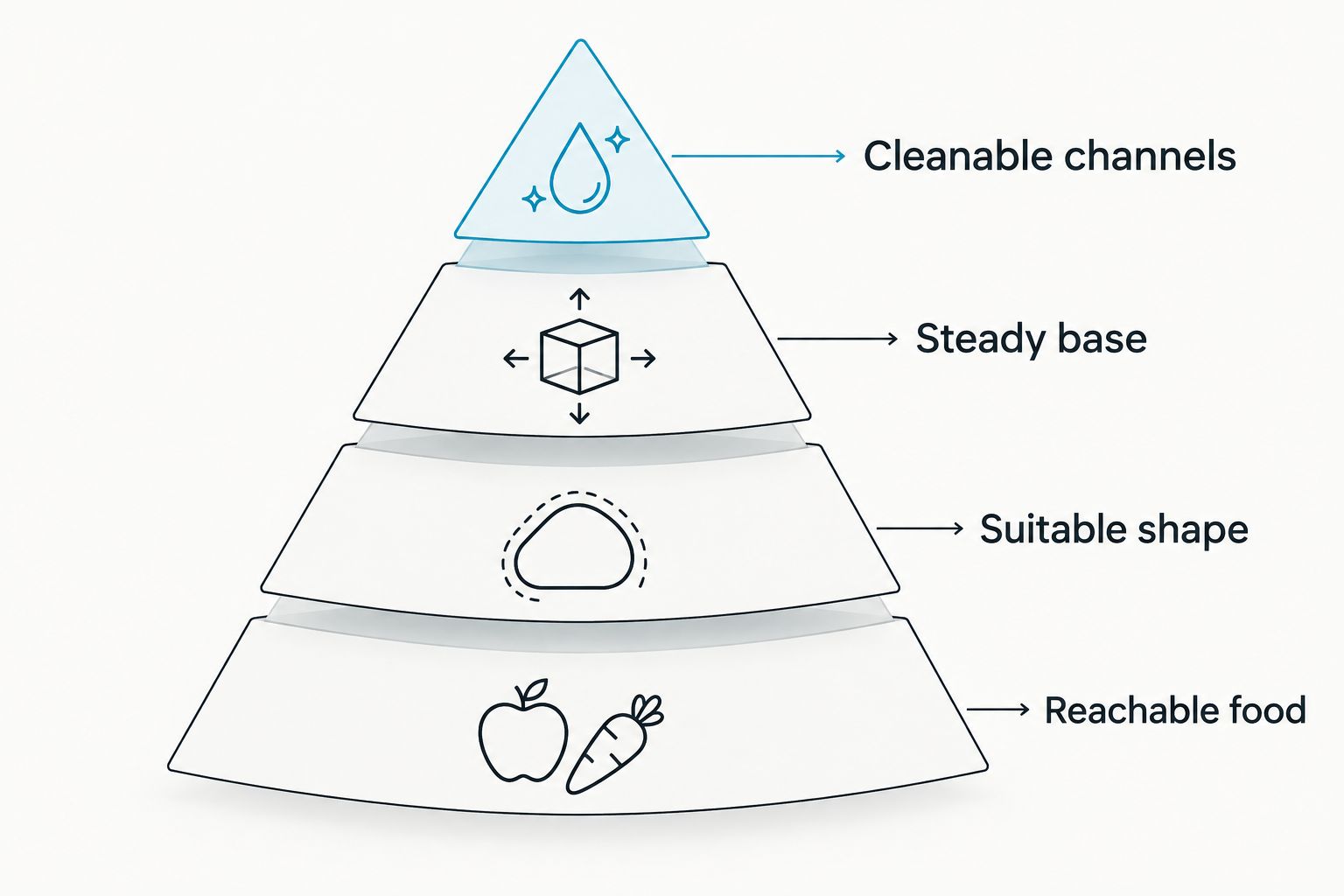
Use these checks before you compare patterns. The goal is a comfortable meal, not the hardest puzzle you can find.
- Reachable food: Look at the spaces between ridges. Your dog should be able to collect food without repeatedly pushing it out or giving up.
- A suitable shape: Check the bowl's width, depth, and ridge height against your dog's muzzle. A broad, shallow surface is a sensible starting point when deep channels look restrictive.
- A steady base: Set the empty bowl where meals happen. If it skates across the floor, look for a stable or suction-base design that suits that surface.
- Cleanable channels: Run your fingers around the ridges. Corners that trap food will also take more work to wash.
- Food compatibility: Dry food, wet food, and mixed meals sit differently around ridges. Check the manufacturer's instructions before using a bowl with a food or cleaning method.
- Safe condition: Inspect for cracked edges, loose parts, or material your dog chews. Remove a damaged bowl rather than leaving it at mealtime.
In 2026, start with access and cleaning before appearance. Watch your dog eat a normal meal from any new bowl. If food remains only in spots your dog cannot reach, that is a design mismatch, not a training problem.
Best slow feeder dog bowls at a glance
These are bowl designs, not claims that a particular model has been tested or is stocked by EverstockPets. Each earns a different job in the 2026 shortlist.
| Bowl design | Best for | Standout feature | Key limitation |
|---|---|---|---|
| Wide, shallow maze bowl | Everyday feeding | Food spread across reachable channels | Some patterns still have tight corners |
| Simple ridge bowl | First-time slow feeders | Less complicated route to the food | May not change how a determined dog eats |
| Suction-base slow feeder bowl | Smooth floors | Base intended to resist sliding | Suction depends on the surface and upkeep |
| Bowl with removable slow-feeder insert | Owners who prioritize cleaning | Insert and bowl can be washed separately | Loose inserts require careful fit and supervision |
| Stainless-steel ridge bowl | Owners who prefer a metal bowl | Fixed ridges within a metal bowl | Shape choices and channel access still matter |
1. Wide, shallow maze bowl: best overall for everyday feeding
A wide, shallow maze spreads food around raised paths without making the dog work at the bottom of a deep bowl. It is the best default when you want a slower-feeding layout but do not know whether your dog will tolerate a complicated puzzle. Choose the actual bowl by checking that its open spaces fit your dog's muzzle.
Wide, shallow maze bowl pros:
- Spreads a meal across more of the bowl's surface.
- Lets you see where food gets stuck while your dog eats.
- Gives you a practical starting point for comparing ridge patterns.
Wide, shallow maze bowl cons:
- A busy maze can still trap food in narrow corners.
- A wide bowl needs enough floor space and a steady base.
Best for: An everyday eater who can reach food throughout a shallow bowl. Verdict: Buy a design with open, washable channels; skip a pattern your dog cannot clear.
Do a simple first-meal check. Serve your dog's usual food, stay nearby, and look for repeated frustration at the same ridge. If the dog leaves food in one channel while eating the rest, try a less restrictive layout before assuming the bowl is helping.
2. Simple ridge bowl: best for dogs new to slow feeding
A simple ridge bowl breaks up the open eating space without building a long maze. It suits a dog learning to eat around obstacles, and it gives you a clear view of whether a slow-feeder layout is comfortable. The ridges still need to leave enough space for your dog's nose and tongue.
Simple ridge bowl pros:
- Easy to assess during a first supervised meal.
- Fewer channels to check for trapped food.
- A less demanding introduction than a dense maze.
Simple ridge bowl cons:
- A dog that eats around the ridges with no change in pace gets little benefit.
- Tall or closely spaced ridges can still block access.
Best for: A dog trying a slow feeder for the first time. Verdict: Buy if your dog can reach the full meal comfortably; hold if the bowl simply moves the difficulty from eating quickly to getting food out.
For a small dog, judge the ridge spacing by the dog in front of you, not a generic size label. For a short-muzzled dog, pay particular attention to whether the face can reach between ridges without pressing against them.
3. Suction-base slow feeder bowl: best for smooth floors
A suction-base design combines feeding ridges with a base intended to hold the bowl in place. It addresses a practical problem: some dogs push a lightweight bowl around while working through a meal. The feeding pattern and the suction are separate decisions, so check both.
Suction-base slow feeder bowl pros:
- Can reduce bowl movement on a compatible smooth surface.
- Keeps the feeding area in one place when the base holds.
- Lets you assess floor stability before changing your feeding setup.
Suction-base slow feeder bowl cons:
- Suction is not a dependable choice on every floor surface.
- A base that collects food or moisture needs cleaning underneath.
- Strong suction does not make an inaccessible ridge pattern suitable.
Best for: A dog whose bowl slides on a smooth feeding surface. Verdict: Buy only after checking the manufacturer's surface guidance and testing the base where your dog eats; skip it if the bowl will sit on an incompatible surface.
Clean and inspect the underside as carefully as the food channels. If your dog picks up, chews, or pulls at the bowl, supervise meals and remove the bowl afterward rather than relying on suction to keep it safe.
4. Removable-insert bowl: best for owners who prioritize cleaning
A removable slow-feeder insert sits inside a separate bowl and creates barriers around the food. Its appeal is straightforward: you can take the parts apart for washing. Fit matters more than convenience, because an insert that shifts or comes loose is not a good mealtime tool.
Removable-insert bowl pros:
- Separates the feeding surface from the bowl for cleaning.
- Lets you inspect the space beneath the insert.
- Provides an option when an integrated maze is awkward to wash.
Removable-insert bowl cons:
- You must confirm that the insert fits the bowl as instructed.
- A dog that chews or lifts the insert needs a different design.
- Washing separate parts adds a step after each meal.
Best for: An owner who wants access to every surface during cleanup and can supervise use. Verdict: Hold until you have checked fit, attachment, material condition, and your dog's behavior; skip a loose insert for a dog that mouths bowl parts.
In 2026, treat a removable insert as a cleaning choice, not proof of better slow feeding. Watch the first meal. If the insert moves before the dog finishes, choose an integrated bowl with easier-to-clean channels instead.
5. Stainless-steel ridge bowl: best for owners who prefer metal
A stainless-steel ridge bowl builds the feeding barriers into a metal bowl. It is a material choice as much as a slow-feeding choice: the dog still needs to reach the food, and the bowl still needs to stay put. Examine the exact ridge layout rather than assuming metal makes every design equally practical.
Stainless-steel ridge bowl pros:
- Offers a metal alternative to plastic or silicone designs.
- Fixed ridges avoid a separate insert to position.
- An open ridge pattern makes leftover food easier to spot.
Stainless-steel ridge bowl cons:
- A lightweight bowl can move if its base is not stable.
- Tight fixed channels remain difficult to clean or reach.
- Material alone does not tell you whether the bowl suits wet food.
Best for: An owner who prefers a metal bowl and finds a ridge pattern their dog can use. Verdict: Buy for material preference when fit and stability check out; skip it if the available shape makes feeding awkward.
Check the manufacturer's cleaning instructions for the particular bowl. Do not assume that every metal bowl, coating, or attached base has the same care requirements.
How we ranked these designs
This 2026 ranking puts reachable food first, then shape, stability, cleaning, and food compatibility. It ranks use cases rather than named models because the supplied product information does not identify a slow feeder bowl to assess. EverstockPets does not present an unrelated pet product as a bowl recommendation.
The order is a starting point, not a reason to ignore your dog. A simple ridge bowl outranks a complex maze for a dog that cannot clear tight channels. A stable base outranks a preferred material when the bowl otherwise slides through dinner. Recheck the same points after a change in food texture or feeding position.
Which slow feeder dog bowl should you choose?
Choose a wide, shallow maze bowl if you need one default for 2026. It gives you an accessible-looking layout to inspect before and during the first meal. If your dog is new to slow feeding, choose the simpler ridge bowl instead; if the bowl slides on a smooth floor, consider a suction base only when it works on that surface.
A slow feeder is a fit decision, not a contest to make dinner difficult. EverstockPets's practical rule is to keep the design your dog can use and you can wash thoroughly. If your dog repeatedly cannot reach food, refuses the bowl, or chews its parts, stop using that design.
FAQ
What are the best slow feeder dog bowls in 2026?
A wide, shallow maze bowl is the best starting point for many everyday eaters in 2026. Check that your dog reaches all the food and that you can clean every channel.
Is a maze bowl better than a simple ridge bowl?
A maze bowl is not better if your dog struggles to reach its food. Start with a simple ridge bowl for a first-time user, then judge the fit during a supervised meal.
Which slow feeder bowl suits a short-muzzled dog?
Choose a broad, shallow design with open spaces your dog can reach. Avoid ridges that force your dog to press its face into narrow or deep channels.
Can I use wet food in a slow feeder bowl?
Use wet food only when the particular bowl's instructions allow it and you can clean its channels thoroughly. A crowded pattern makes leftover food harder to remove.
Do suction-base slow feeder bowls work on every floor?
No. Check the manufacturer's surface guidance and test the base on your feeding surface before relying on it to hold during a meal.
Are removable slow-feeder inserts safe for dogs that chew bowl parts?
Skip a removable insert if your dog lifts or chews it. Choose a suitable integrated design, supervise meals, and remove damaged feeding equipment.
Will a slow feeder treat vomiting or a medical problem?
No. A slow feeder changes access to food; it does not diagnose or treat a medical problem. Ask your veterinarian about repeated vomiting, swallowing trouble, or a sudden change in appetite.
One last thing
The easiest bowl to live with is often the one with the least complicated pattern that works for your dog. Before settling on a 2026 pick, check the channels after a normal meal: unreachable leftovers tell you more about fit than the pattern's appearance does.