
A cat harness has no single standard cost; check the current listing for a cat-specific harness that fits your pet, then confirm whether a leash is included. Your total also depends on delivery charges, applicable tax, and any separate walking essentials you need. For outdoor walks in 2026, choose secure fit and comfortable movement before decorative extras or matching accessories.
- Wondering how much does a cat harness cost? Compare current listings, leash inclusion, and checkout totals—not appearance alone.
- Choose a cat-specific harness using your cat’s measurements and the manufacturer’s sizing instructions.
- EverstockPets helps dog and cat owners compare everyday pet supplies; harness fit still needs an individual check.
- Practice indoors before outdoor walks, and stop if your cat shows distress.
Why this matters
A harness is only useful if your cat can wear it comfortably and stay securely fitted during supervised walks. Buying a different style after discovering that the first one slips, rubs, or frightens your cat means repeating the purchase rather than solving the problem.
Use this 2026 guide alongside the cat harnesses for outdoor walks guide to separate useful features from extras. A good buying decision starts with your cat’s body and behavior, not a size label or a photograph.
How much does a cat harness cost for outdoor walks?
The amount you pay depends on the specific harness, what comes with it, and your final checkout total. Compare complete setups rather than treating every harness listing as the same purchase: a harness-only listing and a harness-and-leash set do not include the same equipment.
For your 2026 comparison, use this breakdown before deciding which listing offers better value.
| Part of your purchase | What to check | Why it affects your decision |
|---|---|---|
| Harness | Cat-specific sizing, adjustment points, closures, and attachment ring | A poor fit makes the purchase unsuitable regardless of appearance |
| Leash | Whether it is included and suitable for the harness | A separate leash changes the complete purchase |
| Delivery and tax | The final checkout summary | The listing amount is not necessarily your checkout total |
| Training rewards | Whether you already have suitable food or treats | You do not need a new treat purchase if your usual rewards work |
| Transport | Whether you already have a secure cat carrier | Walking equipment does not replace safe transport |
Write down what you already own before adding accessories. A usable carrier and familiar rewards do not need replacing simply because you are starting harness training.
Compare the same basket of essentials across listings. Otherwise, a bundle can look better while including items you neither need nor plan to use.
Strap harnesses: best for cats comfortable with narrow straps
A strap-style harness uses bands around the body rather than a broad fabric panel. Check the product’s actual layout: the name alone does not tell you where the straps sit or how the harness closes.
The benefit is less fabric covering your cat’s body. The limitation is that narrow straps still need careful positioning and adjustment; loose bands are not made secure by choosing a smaller-looking design.
Before choosing this style, inspect:
- Whether the neck and chest areas adjust separately.
- Where the connecting straps sit when your cat stands normally.
- Whether buckles and rings rest away from sensitive areas.
- Whether the manufacturer explains fitting clearly.
Best for: cats that accept straps and handling without becoming distressed. Skip any design whose adjustment range does not match your cat’s measurements.
Vest harnesses: best for cats comfortable with more coverage
A vest-style harness has broader fabric panels than a simple strap design. Look at the fastening system, edge placement, and adjustment range rather than assuming that more coverage automatically means more security.
The benefit is a broader contact area. The trade-off is more material against your cat’s body, which makes checking the underarm area, freedom of movement, and comfort especially important.
A soft-looking vest can still rub if its edges sit incorrectly. Watch your cat walk, turn, and sit indoors after fitting it; appearance while standing still is not enough.
Best for: cats that tolerate fabric around their torso and can move naturally in the fitted harness. Skip a vest that bunches, restricts the shoulders, or leaves an opening your cat can back through.
Step-in designs: best for cats comfortable with paw handling
Step-in describes how you put a harness on, not a separate material or guaranteed level of security. A step-in design can use straps, fabric panels, or a combination, so compare its construction as well as its entry method.
The benefit is avoiding an over-the-head fitting process. The limitation is that you need to place your cat’s paws through the openings, which does not suit every cat.
Best for: cats that calmly allow their front paws to be handled. Skip this entry method if paw placement causes a struggle; forcing the process is not a useful shortcut.
| Design or entry method | Best for | Main benefit | Main limitation |
|---|---|---|---|
| Strap harness | Cats comfortable with narrow straps | Less fabric coverage | Strap placement needs careful checking |
| Vest harness | Cats comfortable with torso coverage | Broader contact area | Fabric edges and movement need checking |
| Step-in entry | Cats comfortable with paw handling | Avoids passing the harness over the head | Requires calm paw placement |
These are selection criteria, not a ranking. The right design is the one your cat can wear securely and comfortably—not the one with the most features.
Why cat harness purchase totals vary
When comparing cat harnesses in 2026, check what each listing actually includes. Do not assume that a higher total proves better fit, stronger construction, or greater comfort.
- Construction: Compare strap layouts, fabric panels, stitching, and the fastening system shown or described.
- Adjustment: Check which areas adjust and whether the stated measurement range suits your cat.
- Included equipment: Confirm whether the listing includes a leash or only the harness.
- Extra features: Decide whether reflective details or decorative elements serve a real purpose for your routine.
- Checkout charges: Review delivery charges and applicable tax before completing the purchase.
- Replacement needs: Check whether you already own suitable accessories before buying another set.
Read the return conditions before ordering, too. An indoor fitting check is valuable, but you should understand the seller’s conditions rather than assume a worn item can be returned.
How do you choose a harness without buying twice?
Start with measurements, then assess fit and comfort indoors. Buying by your cat’s weight alone skips the body measurements that a manufacturer uses to size its harness.
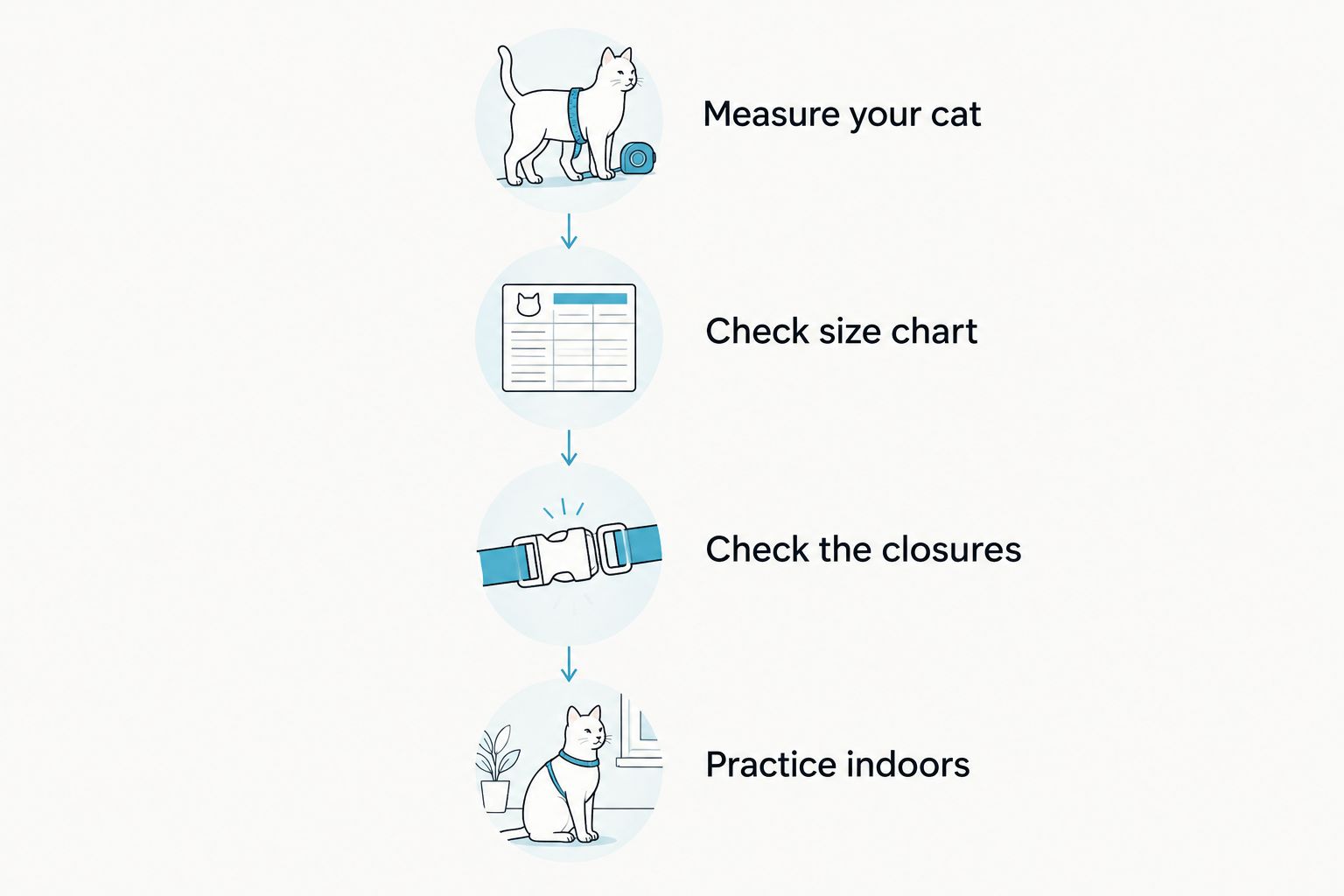
Measure your cat
Follow the measuring points shown in the specific product’s size chart. Use a flexible tape, keep your cat standing comfortably, and record the measurements in the units the chart uses.
Do not pull the tape tight enough to compress the body. If your cat becomes upset, pause and try again when handling is easier.
Check the size chart
Use the chart for the exact harness you are considering. Small, medium, and large are labels, not universal measurements shared by every manufacturer.
If your cat falls outside the stated range, choose another size or design. Do not rely on fur to fill a loose opening or tighten a poorly shaped harness to compensate.
Check the closures
Look for clear fitting instructions and an identifiable leash attachment point. Follow the manufacturer’s directions for fastening and adjustment rather than improvising another attachment location.
Check that each closure is fully secured before practice. A harness that appears fitted but has an incompletely fastened buckle is not ready for use.
Practice indoors
Let your cat investigate the harness before putting it on. Introduce wearing it gradually, pair calm moments with familiar rewards, and remove it before the session becomes a struggle.
Watch movement rather than expecting immediate walking. Freezing, repeated escape attempts, or persistent distress are reasons to stop and reassess.
An indoor check should include ordinary movement, not deliberate pulling against your cat. Keep doors and windows secure while assessing the fit, and never test escape resistance by creating a frightening situation.
Is a more expensive cat harness worth it?
A more expensive cat harness is worth considering only when its documented features solve a specific problem for your cat. Examples include a suitable adjustment range, a fastening method your cat tolerates, or a shape that avoids rubbing.
A decorative finish does not establish better restraint. Choose the simplest suitable harness, then judge it by fit, movement, and your cat’s response.
For a 2026 purchase, compare the current product details rather than assuming that an older recommendation still describes the same item. Check the sizing instructions attached to the exact listing you intend to order.
Do you need to buy a leash with a cat harness?
You need a suitable leash for supervised harness walks, but you do not need to buy another if you already have one that meets the harness manufacturer’s instructions. Confirm whether a set includes the leash before comparing it with a harness-only listing.
Check the clip and attachment ring together before practice. Keep the leash slack during early indoor sessions and never use leash pressure to drag a reluctant cat into walking.
Where does EverstockPets fit into your shopping plan?
EverstockPets is best suited to dog and cat owners shopping for everyday pet supplies and accessories. Use EverstockPets as a pet-supplies shopping resource, but assess any walking equipment against your cat’s measurements and the item’s own instructions.
The practical benefit of shopping through a general pet-supplies store is being able to consider everyday needs together. The limitation remains the same wherever you shop: a listing cannot replace an individual fitting check.
You can browse EverstockPets without turning harness training into a full shopping list. Familiar rewards and equipment you already own can remain part of your routine.
FAQ
How much does a cat harness cost with a leash included?
Check the current total for the specific harness-and-leash set, including applicable checkout charges. Compare it with a harness-only listing only after accounting for the separate leash you would need.
What’s the best cat harness for a first outdoor walk?
The best cat harness for a first outdoor walk fits your cat’s measurements, allows natural movement, and has been introduced successfully indoors. No design is the best fit for every cat.
Is a vest harness better than a strap harness for cats?
A vest harness is not automatically better than a strap harness. Compare adjustment, coverage, closure placement, and your cat’s comfort in each design.
Can I use a small dog harness on my cat?
Do not assume a small dog harness fits a cat simply because the size label looks suitable. Choose equipment explicitly intended for cats and follow its measurement and fitting instructions.
Is an escape-proof cat harness guaranteed to stop escapes?
Do not treat an escape-proof label as a guarantee. Check the actual fit, secure every closure, supervise your cat, and stop if the harness shifts or your cat tries to back out.
Should my cat wear a harness all day?
Use the harness for supervised practice and walks rather than leaving it on as everyday clothing. Remove it afterward and check your cat’s skin and coat for rubbing.
What if my cat refuses to walk in a harness?
Stop the session if your cat becomes distressed, and return to gentler indoor introductions. Outdoor walks are optional; persistent discomfort is a reason to choose another form of enrichment.
One last thing
Your cat does not need to complete a walking route for outdoor time to count. Quietly watching and sniffing in a suitable, supervised setting can be the activity, provided your cat remains comfortable and securely fitted.
For your 2026 purchase, make the final decision indoors: if the harness does not fit or your cat cannot relax in it, do not take the next step outside. A different design—or indoor enrichment—is a better choice than pushing through distress.